
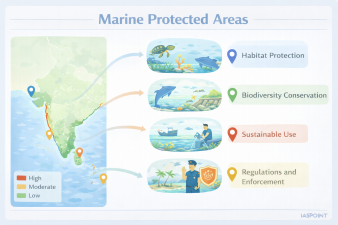
The marine and coastal ecosystems of India are among the most biologically diverse globally, supported by a coastline of approximately 7,516 km (often cited as ~8,118 km including island territories) and an Exclusive Economic Zone (EEZ) of over 2.02 million square km. Marine Protected Areas (MPAs) are essential for safeguarding these “blue” carbon sinks and biodiversity hotspots.
Definition and Legal Framework
A Marine Protected Area is a clearly defined geographical space in the ocean or littoral zone where human activity is strictly regulated to protect natural and cultural resources.
- Wildlife (Protection) Act, 1972: The primary legislation for establishing MPAs. It categorizes protected areas into National Parks, Wildlife Sanctuaries, Conservation Reserves, and Community Reserves.
- Environment (Protection) Act, 1986: Provides the umbrella for Coastal Regulation Zone (CRZ) notifications which manage developmental activities near the shore.
- IUCN Classification: India’s MPAs are mapped to IUCN categories, where National Parks generally align with Category II (Ecosystem protection) and Wildlife Sanctuaries with Category IV (Habitat/Species management).
- BBNJ Treaty (High Seas Treaty): Adopted in 2023 and entering into force in 2026, this treaty provides a legal framework for establishing MPAs in international waters beyond national EEZs.
Classification of MPAs in India
India’s MPAs are generally categorized based on their geographic location and the nature of the ecosystem they protect.
| Category | Description | Primary Examples |
| Category I | Marine National Parks & Sanctuaries with entire areas in the sea. | Gulf of Kutch Marine NP, Mahatma Gandhi Marine NP. |
| Category II | Protected areas with part of the area in the sea and part on land. | Sundarbans NP, Bhitarkanika NP, Gahirmatha Sanctuary. |
| Category III | Small island territories or rocky outcrops. | South Button Island NP, Pitti Island Sanctuary (Lakshadweep). |
Major Marine Protected Areas and Their Features
India has over 120 designated MPAs, predominantly concentrated in the Andaman and Nicobar Islands and along the eastern and western coasts.
1. Gulf of Mannar Marine National Park (Tamil Nadu)
- Located in the biosphere reserve, it consists of 21 islands.
- Home to the Dugong (Sea Cow), India’s only herbivorous marine mammal (Vulnerable, Schedule I).
- Features extensive seagrass beds and coral reefs.
2. Gahirmatha Marine Sanctuary (Odisha)
- The world’s largest nesting ground for Olive Ridley Sea Turtles.
- Famous for the phenomenon of Arribada (mass nesting).
- Located adjacent to the Bhitarkanika Mangroves.
3. Gulf of Kachchh Marine National Park (Gujarat)
- India’s first Marine National Park.
- Characterized by intertidal mudflats and coral reefs that can be explored by foot during low tide.
- Key species include octopuses, pufferfish, and sea anemones.
4. Mahatma Gandhi Marine National Park (Andaman Islands)
- Comprises 15 islands including Labyrinth Islands.
- Protects diverse coral species and nesting sites for Green and Hawksbill turtles.
Comparison of Key Ecosystems in MPAs
Coastal ecosystems differ significantly in their environmental requirements and geographic distribution.
| Ecosystem | Key Requirements | Major MPA Presence |
| Coral Reefs | Shallow, clear, warm waters (20° C to 30° C). | Lakshadweep (Atolls), Gulf of Mannar, Andaman Islands. |
| Mangroves | Intertidal zones, high sediment, brackish water. | Sundarbans, Bhitarkanika, Coringa WLS. |
| Seagrass | Soft sediment, shallow sunlit waters. | Palk Bay, Gulf of Mannar, Chilika Lake. |
Species of High Conservation Priority
For UPSC Prelims, focus on the following species often found within MPA boundaries:
- Olive Ridley Turtle: Vulnerable; Gahirmatha is the primary site.
- Irrawaddy Dolphin: Endangered; found in Chilika Lake (Odisha).
- Sea Cucumbers: All species in India are protected under Schedule I of WPA 1972. They are vital for nutrient recycling.
- Saltwater Crocodile: Found in Bhitarkanika and the Andaman Islands.
Global and National Targets (2025-2026 Updates)
- 30×30 Target: Under the Kunming-Montreal Global Biodiversity Framework, India aims to protect 30% of its marine and land area by 2030.
- MISHTI Scheme: Launched to revitalize mangrove cover along the coastline using MGNREGS and CAMPA funds.
- Blue Economy 2.0: Focuses on the “restoration and adaptation” of coastal ecosystems alongside sustainable maritime trade.
- Deep Ocean Mission: A national mission for exploring deep-sea biodiversity and mineral resources (Polymetallic Nodules) in the Central Indian Ocean Basin.
Quick Trivia for Prelims
- Smallest National Park: South Button Island NP in the Andaman and Nicobar Islands is one of the smallest MPAs.
- Coral Absence: The Sundarbans does not have coral reefs because the high freshwater discharge from the Ganga-Brahmaputra makes the water too turbid and fresh for coral growth.
- First MPA: The Gulf of Kutch Marine National Park was the first to be established (1982