
Productivity in an ecosystem refers to the rate of generation of biomass in an ecosystem. It is expressed in terms of mass per unit area per unit time (e.g., g/m2/yr) or energy per unit area per unit time (e.g., kcal/m2/yr). It is a key indicator of the health and functional status of an environment.
Primary Productivity
Primary productivity is the rate at which solar energy is captured by autotrophs (producers) during photosynthesis to produce organic compounds.
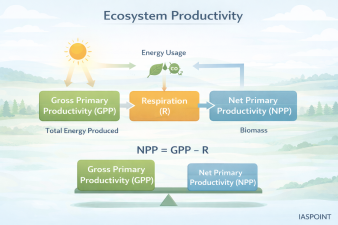
Gross Primary Productivity (GPP)
GPP is the total rate at which organic matter is synthesized by producers per unit area and time. It includes the energy used by the plants for their own survival and growth.
Net Primary Productivity (NPP)
NPP is the energy that remains after plants have met their respiratory needs. This is the actual biomass available for consumption by heterotrophs (herbivores and decomposers).
- Mathematical Relation: NPP = GPP – R (where R is energy lost in respiration).
- UPSC Fact: NPP is the main driver of the global carbon cycle and determines the energy limit for all higher trophic levels.
Secondary Productivity
Secondary productivity is the rate of formation of new organic matter by consumers (heterotrophs). It represents the efficiency with which consumers convert the chemical energy of their food into their own biomass.
Factors Affecting Productivity
Productivity is not uniform across the globe; it depends on several abiotic and biotic variables:
- Solar Radiation: Areas with high insolation (Equatorial regions) generally show higher productivity.
- Temperature: Warm temperatures accelerate metabolic and photosynthetic rates.
- Moisture: Availability of water is a primary limiting factor in terrestrial ecosystems like deserts.
- Nutrient Availability: In aquatic ecosystems, nitrogen and phosphorus are often the limiting factors.
- Photosynthetic Capacity: The type of plant species and their chlorophyll content.
Global Patterns of Productivity
Ecosystems vary significantly in their NPP. Understanding these variations is crucial for UPSC Prelims.
| Ecosystem Type | Productivity Level | Reason |
| Tropical Rainforests | Extremely High | Abundant sunlight, high rainfall, and year-round growing season. |
| Estuaries & Coral Reefs | Extremely High | High nutrient availability and shallow water allowing light penetration. |
| Temperate Forests | High/Moderate | Seasonal growth; limited by cold winters. |
| Oceans (Open) | Low (per unit area) | Nutrient limitation (nutrients sink to the bottom) and light attenuation with depth. |
| Deserts / Tundra | Very Low | Extreme lack of water (Deserts) or extreme cold (Tundra). |
Key Concepts and Trivia
- Limiting Factors: In terrestrial ecosystems, temperature and moisture are the main limiters. In marine ecosystems, light and nutrients (Nitrogen/Iron) are the main limiters.
- The “Ocean Paradox”: While open oceans have low productivity per unit area, they contribute significantly to total global productivity due to their massive surface area (covering 70% of Earth).
- Deep Sea Productivity: In the absence of sunlight, productivity occurs through Chemosynthesis near hydrothermal vents, using chemical energy from hydrogen sulfide (H2S).
- Net Community Productivity (NCP): The rate of storage of organic matter not used by heterotrophs (consumers and decomposers). NCP = NPP – HR (where HR is Heterotrophic Respiration).
Ecological Efficiency
This is the percentage of energy transferred from one trophic level to the next.
- Photosynthetic Efficiency: Only about 1–5% of incident solar energy (or 2-10% of Photosynthetically Active Radiation – PAR) is captured by plants as GPP.
- Net Production Efficiency: The ratio of NPP to GPP, showing how much energy a plant keeps after respiration.
Human Impact on Productivity
- Eutrophication: Excessive nutrient runoff leads to “cultural eutrophication,” causing an initial spike in primary productivity (algal blooms) but eventually leading to oxygen depletion and ecosystem collapse.
- Deforestation: Reduces the global terrestrial NPP and alters the carbon sequestration capacity of the biosphere.
- Climate Change: Shifts in temperature and rainfall patterns are redistributing productivity, often decreasing it in tropical zones while slightly increasing it in high-latitude regions due to longer growing seasons.