

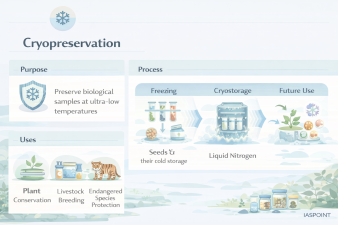
Cryopreservation is an ex-situ conservation technique where biological materials—such as seeds, pollen, embryos, tissues, or DNA—are preserved by cooling them to ultra-low temperatures. It is the most effective method for long-term storage of plant genetic resources that cannot be preserved through conventional seed banking.
- Standard Temperature: Typically conducted in liquid nitrogen at -196°C (77 K).
- Biological State: At these temperatures, all metabolic and enzymatic activities in the cell virtually stop, leading to a state of “suspended animation”.
- Longevity: Theoretically, biological material can be stored indefinitely without genetic alteration or degradation.
The Process and Scientific Mechanism
The primary challenge in cryopreservation is preventing the formation of intracellular ice crystals, which can rupture cell membranes and kill the specimen.
- Vitrification: This is the most common technique used today. It involves the transition of water directly into a glass-like amorphous solid state without the formation of ice crystals.
- Cryoprotectants (CPAs): Chemical substances (like Glycerol or Dimethyl Sulfoxide) added to the cells to lower the freezing point and protect them from dehydration and cold stress.
- Desiccation: Reducing the water content of the tissue before freezing to minimize the volume of water available to freeze.
Types of Plant Material Conserved
Cryopreservation is specifically vital for species that are difficult to conserve through other means.
| Category | Description | Examples |
| Recalcitrant Seeds | Seeds that die if dried or frozen conventionally. | Mango, Rubber, Jackfruit, Cocoa. |
| Vegetatively Propagated | Plants that do not produce seeds or are clones. | Potato, Sweet Potato, Banana, Cassava. |
| Pollen | Preserved for use in plant breeding and hybridization. | Fruit tree pollen, rare orchid pollen. |
| Rare/Endangered Flora | Species with extremely low seed viability. | Specific Himalayan medicinal herbs. |
Cryopreservation in India
India operates one of the most advanced cryo-storage facilities globally to safeguard its agricultural and floral heritage.
National Cryobank (NBPGR)
The National Bureau of Plant Genetic Resources (NBPGR) in New Delhi houses a specialized National Cryobank.
- It utilizes liquid nitrogen-based large-scale vats.
- As of recent records, it hosts over 13,000 accessions of various plant species in cryo-storage.
- It focuses heavily on the wild relatives of crops (WRCs) and indigenous fruit varieties.
Advantages and Limitations
| Advantages | Limitations |
| Space Efficiency: Thousands of samples can be stored in small liquid nitrogen tanks. | Technical Expertise: Requires highly skilled personnel and specialized equipment. |
| Low Maintenance: Does not require constant monitoring of humidity or light. | High Initial Cost: Setting up the infrastructure and sourcing liquid nitrogen is expensive. |
| Genetic Stability: Negligible risk of mutations over centuries. | Species Specificity: Protocol for one plant (e.g., Apple) may not work for another (e.g., Citrus). |
Important Facts for UPSC Prelims
- Cryopreservation vs. Conventional Seed Bank: Seed banks store “orthodox” seeds at -20°C. Cryobanks store “recalcitrant” tissues and seeds at -196°C.
- Liquid Nitrogen: Chosen because it is chemically inert, relatively inexpensive, and maintains a stable ultra-low temperature.
- Biotechnology Link: Cryopreservation is often used in tandem with Micropropagation (Tissue Culture). Tissues grown in labs are often cryopreserved to create “backup” copies of elite plant varieties.
- Animal Genetic Resources: While the focus here is floral, cryopreservation is also the primary method for storing animal semen and embryos in Animal Gene Banks (e.g., at NBAGR, Karnal).