
Wetlands are distinct ecosystems where water covers the soil—either permanently or seasonally. They act as a transition zone between terrestrial and aquatic environments. Under the Ramsar Convention (1971), wetlands are defined broadly to include marshes, fens, peatlands, or water, whether natural or artificial, permanent or temporary, with water that is static or flowing, fresh, brackish, or salt, including areas of marine water the depth of which at low tide does not exceed six meters.
Classification of Wetlands in India
India possesses a diverse range of wetlands, categorized primarily by their location and water salinity:
- Inland Wetlands: Includes oxbow lakes, reservoirs, tanks, waterlogged areas, and seasonal rivers.
- Coastal Wetlands: Includes mangroves, coral reefs, lagoons, creeks, and estuaries.
- Man-made Wetlands: Includes paddy fields, salt pans, and aquaculture ponds.
Ecological and Economic Importance
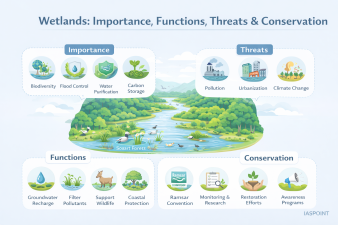
Wetlands are often referred to as the “Kidneys of the Landscape” due to their role in water filtration and nutrient cycling.
Ecosystem Services
- Water Purification: Microorganisms and plants in wetlands absorb excess nutrients (nitrogen and phosphorus) and trap sediments, acting as natural filters.
- Flood Control: They act as natural sponges, absorbing heavy rainfall and reducing the speed of floodwaters.
- Carbon Sequestration: Peatlands, in particular, store vast amounts of carbon, making them vital in mitigating climate change.
- Biodiversity Hotspots: They support high concentrations of birds, mammals, reptiles, and fish. Many are critical stops for migratory birds on the Central Asian Flyway.
Socio-Economic Benefits
- Livelihoods: Millions depend on wetlands for fishing, agriculture (e.g., Makhana cultivation in Bihar), and handicraft materials.
- Groundwater Recharge: By allowing water to percolate into the soil, they maintain the water table in surrounding areas.
Major Threats to Wetland Ecosystems
Despite their importance, wetlands are disappearing three times faster than forests.
- Urbanization and Encroachment: Conversion of wetland areas into residential or industrial zones.
- Pollution: Runoff from agricultural fields (fertilizers/pesticides) and untreated industrial effluents leads to Eutrophication.
- Invasive Species: Growth of Water Hyacinth (Eichhornia crassipes) and Prosopis juliflora depletes dissolved oxygen and chokes native flora.
- Climate Change: Rising sea levels threaten coastal mangroves, while altered precipitation patterns affect inland seasonal wetlands.
Global and National Conservation Frameworks
The Ramsar Convention
An international treaty for the conservation and sustainable use of wetlands.
- Montreux Record: A register of wetland sites on the List of Wetlands of International Importance where changes in ecological character have occurred, are occurring, or are likely to occur. In India, Keoladeo National Park (Rajasthan) and Loktak Lake (Manipur) are currently on this record. Chilika Lake was removed from it in 2002.
Institutional Framework in India
- Wetlands (Conservation and Management) Rules, 2017: These rules decentralize wetland management, giving states the power to identify and monitor wetlands through State Wetland Authorities.
- National Plan for Conservation of Aquatic Eco-systems (NPCA): A merged scheme of the National Wetland Conservation Programme and the National Lake Conservation Plan.
- Amrit Dharohar Scheme: Launched in the 2023-24 Budget to promote unique conservation values of Ramsar sites through community involvement.
Key Facts for UPSC Prelims
| Feature | Details |
| World Wetlands Day | Observed on February 2nd every year (Commemorating the 1971 Ramsar signing). |
| India’s Ramsar Count | India has 85 Ramsar sites (as of early 2024 updates). |
| State with most sites | Tamil Nadu holds the highest number of Ramsar sites in India. |
| Largest Ramsar Site | Sunderbans (West Bengal). |
| Smallest Ramsar Site | Renuka Wetland (Himachal Pradesh). |
| First Ramsar Sites | Chilika Lake (Odisha) and Keoladeo National Park (Rajasthan) were designated in 1981. |
Notable Wetlands and Their Characteristics
- Loktak Lake (Manipur): Famous for Phumdis (floating islands) and the Keibul Lamjao National Park—the only floating national park in the world, home to the Sangai deer.
- Chilika Lake (Odisha): The largest brackish water lagoon in Asia and a major wintering ground for migratory birds.
- Deepor Beel (Assam): A permanent freshwater lake in a former channel of the Brahmaputra River.
- Pala Wetland (Mizoram): The largest natural wetland in Mizoram, steeped in local Buddhist and Mizo folklore.
- Vembanad Kol (Kerala): The longest lake in India, famous for the Nehru Trophy Boat Race.
Conservation Strategies: The Way Forward
- Integrated Management: Linking wetland conservation with river basin management to ensure water inflow.
- Community Participation: Engaging local “Wetland Mitras” for monitoring and preventing encroachment.
- Scientific Mapping: Using geospatial tools for real-time monitoring of water quality and land-use changes.
- Restoration of Hydrology: Removing artificial barriers and invasive species to restore natural water flow and oxygen levels.