

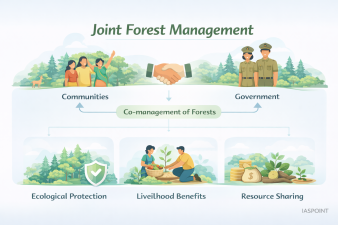
Joint Forest Management (JFM) is a decentralized forest management strategy that involves a partnership between the state forest departments and local communities. It is based on the principle of “care and share,” where communities provide labor and protection for forest land in exchange for a share in the forest produce.
- Origin: While the 1988 National Forest Policy provided the ideological foundation, the formal JFM program was launched via a Government of India resolution in June 1990.
- Precursor (The Arabari Experiment): The concept was successfully pioneered in the early 1970s by forest officer A.K. Banerjee in the Arabari forest range of Midnapore, West Bengal. He involved local villagers in protecting degraded Sal forests in exchange for employment and a 25% share in the final timber harvest.
Institutional Mechanism
The implementation of JFM relies on a formal agreement between the Forest Department and a village-level body.
- Village Level Body: Usually known as the Joint Forest Management Committee (JFMC), Vana Samrakshana Samithi (VSS), or Forest Protection Committee (FPC).
- Composition: The committee consists of all eligible adults in the village. It typically has an Executive Committee that includes representatives from the village and the local Forest Guard (as Member Secretary).
- Memorandum of Understanding (MoU): A formal agreement is signed specifying the rights, responsibilities, and the sharing pattern of forest produce.
Core Objectives
- Restoration: To regenerate degraded forests through community participation rather than through policing.
- Livelihood Security: To provide local communities with access to fuel-wood, fodder, and non-timber forest products (NTFP).
- Sustainable Management: To create a sense of ownership among locals, leading to a reduction in forest fires, grazing, and illegal felling.
Benefit Sharing Mechanism
The JFM model provides both immediate and long-term incentives to the participating communities.
| Type of Benefit | Examples |
| Non-Timber Forest Produce (NTFP) | Grass, fallen twigs, fruits, seeds, medicinal plants, and honey (usually provided for free or at a nominal cost). |
| Timber Share | A fixed percentage of the net profit from the final harvest of timber (ranges from 25% to 50% depending on state rules). |
| Employment | Direct wages for labor-intensive work like trenching, pit digging, and nursery management. |
| Community Fund | A portion of the earnings is often kept in a “Village Development Fund” for local infrastructure like wells or schools. |
JFM and the 1988 National Forest Policy
The 1988 Policy was the turning point that enabled JFM by shifting the focus from commercial timber to meeting the requirements of local people.
- Section 4.3.4.2 of the Policy: Specifically mentions that the holders of customary rights and interests should be motivated to identify themselves with the protection and development of forests.
- Decentralization: JFM moved forest management away from the “Command and Control” model toward a “Participatory” model.
Comparison: JFM vs. Social Forestry
| Feature | Joint Forest Management (JFM) | Social Forestry |
| Land Type | Primarily degraded State Forest lands. | Non-forest lands (roadsides, canals, community land). |
| Partnership | Forest Department + Local Community. | Primarily individual farmers or Panchayats. |
| Primary Goal | Forest regeneration and protection. | Meeting local needs and reducing pressure on natural forests. |
UPSC Prelims: Critical Facts and Trivia
- Nodal Body: At the national level, the JFM cell is located within the Forest Policy Division of the Ministry of Environment, Forest and Climate Change (MoEFCC).
- National Forest Action Programme (NFAP): This 20-year plan incorporated JFM as a core strategy for achieving 33% forest cover.
- Women’s Participation: JFM guidelines mandate the representation of women in the Executive Committee (usually at least 33% or 50% depending on the state).
- The “Arabari” Legacy: West Bengal was the first state to issue a formal Government Order to implement the JFM concept on a large scale.
Evolution and Current Status
The JFM program has evolved over the decades, facing both successes and criticisms:
- Integration with Panchayati Raj: Following the 73rd Constitutional Amendment, efforts were made to integrate JFMCs with the Gram Sabhas to ensure better legal standing.
- Shift to GIM: Many JFM activities are now integrated into the Green India Mission (GIM) and the National Afforestation Programme (NAP).
- Criticism: Critics argue that JFM often remains “Forest Department-driven” rather than “Community-led,” and that the Forest Rights Act (2006) provides much stronger legal rights to communities compared to the administrative nature of JFM.