
Climate justice is an ethical and political framework that views climate change not merely as an environmental or physical phenomenon, but as a social, ethical, and legal issue. It asserts that those who are least responsible for climate change—low-income communities, indigenous peoples, and developing nations—often suffer its gravest consequences.
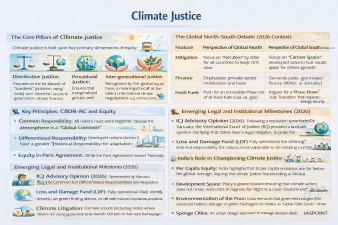
The Core Pillars of Climate Justice
Climate justice is built upon four primary dimensions of equity:
- Distributive Justice: Focuses on the fair allocation of the “burdens” (pollution, rising costs) and “benefits” (access to green tech, climate finance) of climate action.
- Procedural Justice: Ensures that marginalized groups and the “Global South” have a meaningful seat at the table in international climate negotiations (e.g., UNFCCC COPs).
- Inter-generational Justice: Recognizes that current carbon-intensive lifestyles infringe upon the rights of future generations to a stable and habitable planet.
- Restorative Justice: Emphasizes “reparations” for harm already caused, largely manifesting in the global debate over Loss and Damage funding.
Key Principles: CBDR-RC and Equity
The cornerstone of climate justice in international law is the principle of Common but Differentiated Responsibilities and Respective Capabilities (CBDR-RC).
- Common Responsibility: All nations must work together because the atmosphere is a “Global Common.”
- Differentiated Responsibility: Developed nations (Annex I) have a greater “Historical Responsibility” for the accumulated CO2 in the atmosphere since the Industrial Revolution.
- Respective Capabilities: Action must be commensurate with a nation’s wealth and technological advancement.
- Equity in Paris Agreement: While the Paris Agreement moved toward “Nationally Determined” contributions for all, India and the Global South maintain that “Equity” must be the yardstick to measure whether those contributions are “fair.”
The Global North-South Debate (2026 Context)
The tension between developed (Global North) and developing (Global South) nations remains a defining feature of climate diplomacy.
| Feature | Perspective of Global North | Perspective of Global South (India, etc.) |
| Mitigation | Focus on “Net Zero” by 2050 for all countries to keep 1.5°C alive. | Focus on “Carbon Space”; developed nations must vacate space for others’ growth. |
| Finance | Emphasizes private sector mobilization and loans. | Demands public, grant-based finance ($100bn+ annually) for adaptation. |
| Fossil Fuels | Push for an immediate “Phase Out” of all fossil fuels (coal, oil, gas). | Argues for a “Phase Down” and “Just Transition” that respects energy security. |
| Accountability | Focus on current/future emitters (e.g., China, India). | Focus on cumulative historical emissions per capita. |
Emerging Legal and Institutional Milestones (2026)
The year 2026 marks a shift toward “Legal Accountability” for climate justice.
- ICJ Advisory Opinion (2026): Following a resolution spearheaded by Vanuatu, the International Court of Justice (ICJ) provided a landmark opinion clarifying that states have a legal obligation to protect the climate system. It affirmed that failure to act can lead to legal consequences under international law for harming other states.
- Loss and Damage Fund (LDF): Now fully operational, the fund is designed to provide financial assistance to nations most vulnerable to the “unavoidable” impacts of climate change (e.g., island nations sinking due to sea-level rise).
- Climate Litigation: A surge in domestic courts (including India) where citizens are suing governments or corporations for violating the “Right to a Clean Environment” as part of the Right to Life (Article 21 of the Indian Constitution).
India’s Role in Championing Climate Justice
India positions itself as the “Voice of the Global South” in climate forums through several strategic stances:
- Per Capita Equity: India highlights that its per capita emissions are far below the global average, arguing that climate justice requires looking at individual footprints rather than national totals.
- Development Space: Policy is geared toward ensuring that climate action does not hinder the goal of “Viksit Bharat” (Developed India) by 2047.
- Technology Transfer: India demands that green technologies (like advanced battery storage or green hydrogen) be treated as “Global Public Goods” rather than protected by restrictive IP (Intellectual Property) regimes.
- Environmentalism of the Poor: As noted by historian Ramachandra Guha, India’s movements (like Chipko or Narmada Bachao) represent a form of justice where the poor fight to protect the environment because their livelihoods depend on it directly.
Important Facts for UPSC Prelims
- Stockholm+50 (2022) & Beyond: Reaffirmed the link between human rights and a healthy environment, a core tenet of climate justice.
- Carbon Budget: The total amount of CO2 that can be emitted while still limiting warming to 1.5°C. Climate justice advocates argue this budget should be shared based on population and historical usage.
- Just Transition: A framework developed by trade unions to ensure that the shift to a green economy does not leave behind workers in “brown” sectors (e.g., coal miners in Jharkhand).
- Vanuatu’s Resolution: The first time a country successfully petitioned the UN General Assembly to seek a legal opinion from the ICJ on climate change.