

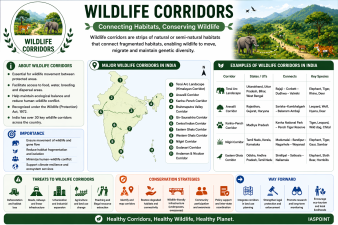
Wildlife corridors, also known as biological or habitat corridors, are strips of land or water that physically connect fragmented habitats. They allow for the safe movement of animals between isolated populations, which is critical for maintaining genetic diversity and preventing local extinctions.
- Connectivity: They link “core areas” (such as National Parks or Sanctuaries) that have been separated by human activities like roads, railways, and agriculture.
- Genetic Flow: By allowing individuals to move and mate with different populations, corridors prevent inbreeding depression.
- Climate Adaptation: Corridors enable species to shift their ranges in response to changing climatic conditions and food availability.
Classification of Wildlife Corridors
Corridors are categorized based on their structure and the specific species they are designed to support.
Structural Corridors
- Linear Corridors: Long, continuous strips of vegetation (e.g., hedgerows or riparian strips along rivers).
- Stepping Stones: A series of small, disconnected patches of habitat that animals “jump” between (e.g., small community reserves or ponds for birds/amphibians).
- Landscape Corridors: Broad tracts of land that maintain connectivity at a regional scale.
Functional Corridors
- Species-Specific Corridors: Designed for the movement requirements of a particular animal (e.g., “Elephant Corridors” or “Tiger Corridors”).
- Macro-corridors: Large-scale links connecting major ecosystems, such as the Terai Arc Landscape.
Major Elephant and Tiger Corridors in India
India’s conservation strategy heavily relies on identifying and protecting corridors for flagship megafauna.
| Corridor Name | Region/State | Connectivity |
| Terai Arc Landscape (TAL) | Uttarakhand to Bihar | Links 16 protected areas across India and Nepal; critical for Tigers and Elephants. |
| Kaniyanpura-Doddasampage | Karnataka | Links Bandipur and Biligiri Ranganatha Temple (BRT) Tiger Reserves. |
| Kanha-Pench Corridor | MP / Maharashtra | One of the most important tiger corridors in the world; used for genetic exchange between two major tiger sources. |
| Kaziranga-Karbi Anglong | Assam | Essential for animals moving to higher ground during the annual Brahmaputra floods. |
| Rewak-Emangre | Meghalaya | A vital elephant corridor in the Garo Hills; involves significant community participation. |
Legal and Institutional Framework
In India, wildlife corridors do not have a specific separate statutory category like National Parks, but they are protected through various administrative and legal overlaps.
- Wildlife (Protection) Act, 1972: Section 38V(3)(b) mandates that tiger conservation plans must provide for the protection of tiger corridors.
- National Tiger Conservation Authority (NTCA): Identifies and monitors 32 major tiger corridors in India.
- Eco-Sensitive Zones (ESZ): Many corridors are notified as ESZs to regulate developmental activities that could block animal movement.
- National Wildlife Action Plan (2017-2031): Prioritizes the “Landscape Approach” over the “Isolated Protected Area Approach.”
Human-Wildlife Conflict and Mitigation
The fragmentation of corridors is the primary cause of Human-Wildlife Conflict (HWC) in India. When a corridor is blocked, animals are forced to pass through human settlements.
Mitigation Measures (Engineering Solutions)
- Eco-Bridges: Specialized structures like canopy bridges (for primates) and underpasses/overpasses for terrestrial animals.
- NH-44 Underpasses: India’s first dedicated animal underpasses were constructed on National Highway 44 passing through the Pench Tiger Reserve (Maharashtra).
- Right of Passage: Initiatives by NGOs like Wildlife Trust of India (WTI) to purchase private land in corridors and hand it over to the Forest Department.
Key Trivia for UPSC Prelims
- Elephant Corridors Report: The “Right of Passage” report (2017) identified 101 functional elephant corridors in India.
- First Canopy Bridge: Located in the Anamalai Tiger Reserve (Tamil Nadu) to assist the movement of the endangered Lion-tailed Macaque.
- Global Tiger Forum (GTF): An international body that works extensively on cross-border corridors (e.g., India-Bhutan-Nepal).
- Green Highways Policy, 2015: Mandates the integration of environmental and wildlife conservation in highway planning.
Threats to Corridors
- Linear Infrastructure: Roads, railway lines (major cause of elephant deaths in North Bengal), and power lines.
- Land Use Change: Conversion of forest land into tea gardens, coffee plantations, or monoculture (e.g., Palm oil).
- Mining: Open-cast mining in Central India (Jharkhand, Chhattisgarh, Odisha) has severely fragmented the “Eastern Ghats-Central India” tiger landscape.