

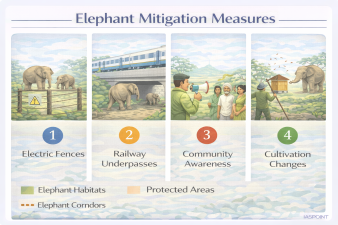
Human-Elephant Conflict (HEC) is a major conservation challenge in India, leading to an average of 500 human deaths and 100 elephant deaths annually. Mitigation measures are broadly categorized into physical barriers, technological interventions, and community-based strategies aimed at fostering coexistence.
Physical and Biological Barriers
Physical barriers are the most common “hard boundary” interventions used to restrict elephant movement into agricultural lands and human settlements.
- Elephant Proof Trenches (EPT): Deep ditches (typically 3m x 2m) dug along forest boundaries.
- Constraint: High maintenance and prone to erosion in high-rainfall areas (>1500 mm).
- Solar-Powered Electric Fencing: Non-lethal fences that deliver a high-voltage but low-current shock.
- Trivia: Elephants have been known to bypass these by using dry branches or tusks (which are non-conductive) to break the wires.
- Hanging Solar Fences: A recent innovation where wires hang from a top cable, making it difficult for elephants to push them over without getting a shock.
- Rail Track Fencing: Utilizing old railway tracks to create a robust vertical barrier. This is highly effective but expensive, predominantly used in high-conflict zones like Karnataka.
- Bio-Fencing (Project RE-HAB): “Reducing Elephant-Human Attacks using Bees.” An initiative by KVIC (Khadi and Village Industries Commission) that involves placing bee boxes on the periphery of forests.
- Mechanism: Elephants are naturally afraid of bees; the buzzing sound and stings act as a psychological deterrent.
Technological and AI-Based Interventions
Modern technology is being leveraged to provide real-time alerts and prevent “accidental” deaths, particularly on railway tracks.
- Gajraj System (Intrusion Detection System): An indigenous AI-based software utilizing Optical Fibre Cables (OFC) to detect vibrations caused by elephant movement within 200 meters of railway tracks.
- Implementation: Deployed by Indian Railways across 700 km of corridors (e.g., Northeast Frontier Railway).
- Early Warning Systems (EWS):
- SMS/Bulk Alerts: Local forest departments send automated text messages to villagers when a collared elephant enters a 1-2 km buffer zone.
- Thermal Cameras: Tower-mounted thermal and motion-sensing cameras (e.g., in Madukkarai, Tamil Nadu) detect movements at night and alert loco-pilots.
- Radio-Telemetry: Fitting “problem” elephants with satellite collars to track their movement in real-time.
Administrative and Community Measures
The MoEFCC emphasizes that technical fixes must be supported by administrative efficiency and community participation.
| Measure | Description |
| Kunki Elephants | Trained captive elephants used by the Forest Department to drive wild herds away from human habitations. |
| Rapid Response Teams (RRT) | Specialized forest units equipped with vehicles and tranquilizing gear to handle emergencies 24/7. |
| Ex-gratia Payments | Standardized financial compensation for crop damage, property loss, or human injury/death to prevent retaliatory killings. |
| Gaj Yatra | A nationwide awareness campaign launched by WTI and MoEFCC to sensitize citizens about the “Right of Passage” for elephants. |
Landscape-Specific Mitigation Packages
The Ministry of Environment (MoEFCC) has recently standardized a “mitigation package” for infrastructure developers to ensure safe wildlife passage.
- Eco-Bridges: Underpasses and overpasses designed with natural vegetation to encourage elephant crossing.
- Bridge Extensions: Modifying existing railway bridges to allow space for elephants to pass underneath.
- Level Crossings & Ramps: Providing designated entry and exit points in areas where trenches or fences would otherwise trap an animal on a railway track or road.