
Ecological tolerance refers to the range of environmental conditions—such as temperature, salinity, pH, or sunlight—within which an organism can survive, grow, and reproduce. Every species has a specific “tolerance envelope.” If an environmental factor exceeds the minimum or maximum limits of this envelope, the species experiences physiological stress or death.
Shelford’s Law of Tolerance
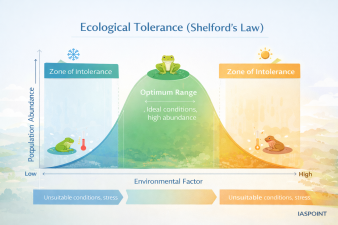
Victor Ernest Shelford expanded upon Liebig’s Law of the Minimum (which focused on single limiting nutrients) in 1913. Shelford’s Law posits that the distribution of a species is controlled by the environmental factor for which the organism has the narrowest range of adaptability.
The Three Zones of Tolerance
Environmental gradients are typically divided into three distinct zones based on the performance of a species:
- Optimum Zone: The central portion of the tolerance range where the population density is highest. Conditions are ideal for growth, health, and reproduction.
- Zone of Physiological Stress: Located on either side of the optimum zone. Organisms can survive but are under stress; growth is stunted, and reproductive success is significantly lowered.
- Zone of Intolerance: The extreme ends of the gradient where the factor is either too scarce or too abundant. Organisms cannot survive here, leading to the total absence of the species.
Determinants of Tolerance Levels
Critical Limits and Steno vs. Eury
Species are classified based on the breadth of their tolerance ranges. These prefixes are essential for UPSC Prelims classification:
- Eury- (Wide): Organisms with a broad range of tolerance. Examples include Eurythermal (can handle wide temperature swings like tigers) or Euryhaline (can handle various salinities like salmon).
- Steno- (Narrow): Organisms with a very restricted range. Examples include Stenothermal (tropical corals that die with slight temperature changes) or Stenohaline (goldfish that only survive in freshwater).
Factors Influencing Tolerance Range
- Synergistic Effects: Tolerance to one factor may be reduced if another factor is at a sub-optimal level. For example, a plant may tolerate low nitrogen if water is abundant, but if water becomes scarce, its nitrogen tolerance decreases.
- Life Stage: Tolerance limits are often narrower for reproductive stages or juveniles than for adults. For instance, adult crabs might survive high salinity, but their larvae may require a specific, narrower range.
Comparative Overview: Liebig’s Law vs. Shelford’s Law
| Feature | Liebig’s Law of the Minimum | Shelford’s Law of Tolerance |
| Primary Focus | Scarcity of nutrients/resources. | Both scarcity and excess of physical/chemical factors. |
| Key Premise | Growth is dictated by the rarest resource. | Growth is dictated by the range of environmental factors. |
| Application | Agriculture and primary productivity. | Population distribution and ecosystem health. |
| Example | Phosphorus in a lake limiting algae growth. | High temperature causing coral bleaching. |
Major Environmental Factors and Species Responses
Temperature (Thermal Tolerance)
Temperature is a primary limiting factor affecting metabolic rates.
- Trivia: The Tardigrade is an exception to standard tolerance laws, surviving temperatures from near absolute zero to 150°C by entering a cryptobiotic state.
- Fact: Most aquatic organisms are more stenothermal than terrestrial ones due to the high specific heat capacity and stability of water.
Salinity (Halic Tolerance)
- Anadromous Fish: Species like Salmon migrate from the sea to freshwater to spawn. They possess high euryhaline tolerance.
- Mangroves: These plants have high salt tolerance through mechanisms like salt excretion (Avicennia) or salt exclusion (Rhizophora).
pH and Chemical Factors
- Acidophiles: Organisms that thrive in highly acidic environments (pH < 3).
- Fact: Most freshwater fish cannot survive in water with a pH lower than 5.0, which is critical for understanding the impacts of Acid Rain.
Ecological Implications for UPSC
Indicators of Environmental Change
Species with narrow tolerance (Stenotopic species) serve as excellent Bio-indicators.
- Lichens: Highly sensitive to Sulfur Dioxide (SO2); their absence indicates air pollution.
- Stonefly Larvae: Indicate high dissolved oxygen levels and low organic pollution in streams.
Acclimation vs. Adaptation
- Acclimation: A reversible, short-term physiological adjustment to a change in an environmental factor (e.g., humans producing more red blood cells at high altitudes).
- Adaptation: A genetic, evolutionary change in a population’s tolerance range over many generations.
Climate Change and Shifting Ranges
As global temperatures rise, species are pushed toward their “Zone of Intolerance.” This forces poleward or upward (altitudinal) migration. If a species cannot migrate fast enough or lacks a suitable new habitat within its tolerance range, it faces extinction. This is particularly evident in alpine flora and montane species.
Last Modified: April 18, 2026