
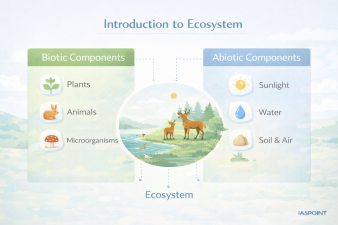
An ecosystem is the fundamental functional unit of the biosphere, consisting of a community of living organisms (biotic) interacting with their non-living physical environment (abiotic). The term was coined by A.G. Tansley in 1935. It represents a self-sustaining system where energy flows through food webs and nutrients are recycled continuously.
Components of an Ecosystem
Ecosystems are comprised of two primary interacting components: Abiotic and Biotic factors.
Abiotic Components (Non-living)
These physical and chemical factors determine the type of organisms that can survive in a specific habitat.
- Inorganic substances: Carbon, Nitrogen, Hydrogen, Phosphorus, and Water (H2O).
- Organic compounds: Proteins, carbohydrates, and lipids which link the abiotic and biotic parts.
- Climatic factors: Sunlight (the ultimate energy source), temperature, humidity, precipitation, and wind.
- Edaphic factors: Soil texture, pH, and mineral composition.
Biotic Components (Living)
Based on their nutritional role, biotic components are classified into three groups:
- Producers (Autotrophs): Green plants and chemosynthetic bacteria that fix solar energy to produce food through photosynthesis.
- Consumers (Heterotrophs): Organisms that depend on producers.
- Primary Consumers (Herbivores): Feed directly on plants (e.g., Deer, Grasshopper).
- Secondary Consumers (Carnivores): Feed on herbivores (e.g., Frog, Small fish).
- Tertiary Consumers (Top Carnivores): Feed on other carnivores (e.g., Lion, Tiger, Eagle).
- Decomposers (Saprotrophs): Microorganisms like fungi and bacteria that break down dead organic matter into simpler inorganic nutrients, completing the nutrient cycle.
Classification of Ecosystems
Ecosystems vary in scale from a small pond to the entire global biosphere. They are generally categorized into Natural and Artificial types.
| Type | Sub-type | Examples |
| Natural Terrestrial | Forest, Grassland, Desert, Tundra | Amazon Rainforest, Savannah, Sahara, Himalayan Alpine |
| Natural Aquatic | Freshwater (Lentic & Lotic), Marine | Lakes (Lentic), Rivers (Lotic), Oceans, Coral Reefs |
| Artificial (Man-made) | Managed systems | Croplands (Rice fields), Aquariums, Urban Parks, Dams |
Functional Aspects of an Ecosystem
For an ecosystem to remain stable, four key processes must occur:
- Productivity: The rate of biomass production. Primary productivity is the rate at which solar energy is captured by producers.
- Decomposition: The breakdown of complex organic matter into inorganic raw materials (CO2, water, nutrients).
- Energy Flow: The unidirectional movement of energy from producers to top consumers. Only about 10% of energy is transferred to the next trophic level (Lindeman’s 10% Law).
- Nutrient Cycling: Also known as Biogeochemical cycles (e.g., Nitrogen cycle, Carbon cycle), where nutrients move between biotic and abiotic components.
Key Ecological Concepts for Prelims
Ecotone
An ecotone is a zone of transition between two or more diverse ecosystems.
- Examples: Mangroves (between terrestrial and marine), Estuaries (between freshwater and saltwater), and Grasslands (between forest and desert).
- Edge Effect: The tendency for an ecotone to have greater species diversity and higher population density than either of the flanking communities.
- Edge Species: Organisms that occur primarily or most abundantly in this transition zone (e.g., specific bird species in forest-grassland edges).
Ecological Niche
The niche is the functional role and specific position a species occupies within an ecosystem.
- It includes the species’ habitat, its activities (what it eats), and its interactions with other species.
- Trivia: No two species can occupy exactly the same niche in the same habitat for long; one will eventually outcompete the other (Gause’s Competitive Exclusion Principle).
Ecocline
An ecocline is a gradual and continuous change in species composition or community structure along an environmental gradient (such as altitude, salinity, or temperature), lacking a sharp boundary.
Ecosystem Properties
- Homeostasis: The inherent capacity of an ecosystem to self-regulate and maintain a state of equilibrium despite disturbances.
- Anthropogenic Influence: Human-made ecosystems (like monoculture plantations) are often unstable and require constant external energy or chemical inputs (fertilizers, pesticides) to survive, unlike natural ecosystems which are self-regulating.