

Environmental, Social, and Governance (ESG) represents a framework used by investors, policymakers, and corporations to evaluate the sustainability and ethical impact of an investment or business operation. Unlike traditional financial analysis, which focuses purely on profit and loss, ESG integrates non-financial factors into the decision-making process to manage risks and identify opportunities in a changing global landscape.
The Three Pillars of ESG
Environmental Criteria
This pillar focuses on a company’s stewardship of the natural world and its impact on the ecosystem.
- Climate Change and Carbon Emissions: Assessment of greenhouse gas (GHG) emissions, carbon footprint, and transition strategies toward net-zero.
- Natural Resource Management: Sustainable sourcing of raw materials, water conservation, and forest management (deforestation).
- Waste and Pollution: Management of hazardous waste, plastic reduction, and circular economy practices.
- Energy Efficiency: Utilization of renewable energy sources and reduction in overall energy intensity.
Social Criteria
The social pillar examines how a company manages relationships with employees, suppliers, customers, and the communities where it operates.
- Labor Standards: Fair wages, prevention of child or forced labor, and adherence to international labor laws.
- Diversity, Equity, and Inclusion (DEI): Gender and ethnic representation in the workforce and leadership roles.
- Human Rights: Protection of indigenous rights and ethical supply chain management.
- Product Safety and Quality: Ensuring consumer protection, data privacy, and cybersecurity.
Governance Criteria
Governance deals with a company’s leadership, executive pay, audits, internal controls, and shareholder rights.
- Board Structure: Diversity of the board, independence of directors, and separation of the CEO and Chairman roles.
- Executive Compensation: Alignment of executive pay with long-term performance and sustainability goals.
- Ethics and Transparency: Robust anti-corruption policies, whistleblower protection, and tax transparency.
- Shareholder Rights: Protecting the interests of minority shareholders and ensuring fair voting rights.
Evolution and Global Regulatory Frameworks
The concept of ESG gained momentum following the 2004 UN report “Who Cares Wins” and the subsequent launch of the Principles for Responsible Investment (PRI).
| Regulation/Framework | Key Objective |
| UN Principles for Responsible Investment (PRI) | A voluntary set of investment principles for incorporating ESG issues into investment practice. |
| Sustainable Finance Disclosure Regulation (SFDR) | EU regulation requiring financial market participants to provide transparency on sustainability risks. |
| Task Force on Climate-related Financial Disclosures (TCFD) | Framework for consistent climate-related financial risk disclosures for use by companies. |
| Global Reporting Initiative (GRI) | International independent standards organization that helps businesses understand and communicate their impact on issues. |
The Indian Perspective: Regulatory and Legal Landscape
In India, ESG reporting has transitioned from voluntary guidelines to mandatory disclosures overseen by the Securities and Exchange Board of India (SEBI).
Business Responsibility and Sustainability Report (BRSR)
Introduced in 2021, BRSR replaced the Business Responsibility Report (BRR). It is mandatory for the top 1,000 listed companies (by market capitalization) to file BRSR. It aligns with the nine principles of the National Guidelines on Responsible Business Conduct (NGRBC).
SEBI’s ESG Disclosures and Ratings
- BRSR Core: A sub-set of the BRSR consisting of critical KPIs for which reasonable assurance is required.
- ESG Rating Providers (ERPs): SEBI has introduced a framework to regulate ESG rating providers to ensure transparency and prevent “Greenwashing.”
- ESG Investing: SEBI mandates that ESG schemes must invest at least 80% of their total assets in securities that have BRSR disclosures.
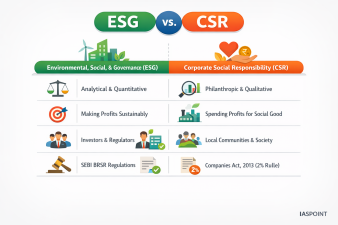
Key Differences: ESG vs. CSR
While often used interchangeably, ESG and CSR (Corporate Social Responsibility) have distinct operational definitions in the Indian context.
| Feature | Corporate Social Responsibility (CSR) | Environmental, Social, and Governance (ESG) |
| Nature | Philanthropic and qualitative. | Analytical and quantitative. |
| Focus | How a company spends its profits for social good. | How a company makes its profits sustainably. |
| Primary Audience | Local communities and society at large. | Investors, regulators, and financial analysts. |
| Legal Mandate | Section 135 of the Companies Act, 2013 (2% of average net profits). | SEBI BRSR regulations for listed entities. |
Challenges in ESG Implementation
- Greenwashing: The practice of making misleading claims about the environmental benefits of a product, service, or investment.
- Data Consistency: Lack of standardized metrics across different industries and geographies makes comparison difficult.
- Rating Divergence: Different ESG rating agencies often assign widely varying scores to the same company based on proprietary methodologies.
- Transition Costs: High initial capital expenditure required for green technology and sustainable supply chain overhauls.
Facts and Trivia for Aspirants
- India’s First ESG Fund: Launched by SBI Magnum Equity ESG Fund (formerly SBI Magnum Equity Fund).
- Sovereign Green Bonds: The Government of India issued its first Sovereign Green Bonds (SGrBs) in 2023 to mobilize resources for green infrastructure.
- Panchamrit Targets: India’s ESG momentum is driven by the COP26 goals, including achieving Net Zero by 2070.
- Materiality: The concept of “Double Materiality” refers to how ESG issues affect a company (Financial Materiality) and how the company affects the environment and society (Impact Materiality).