
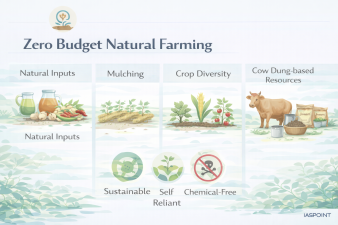
Zero Budget Natural Farming is a holistic alternative to the Green Revolution’s chemical-driven methods. Developed by Indian agriculturist Subhash Palekar, ZBNF aims to bring down the cost of production to nearly zero and return to a system that works in harmony with nature. It is based on the philosophy that all nutrients required for plant growth are available in the soil and atmosphere, provided the soil’s microbial ecosystem is healthy.
The Four Pillars of ZBNF
These four components form the core technical framework of the ZBNF model, designed to eliminate the need for external fertilizers and pesticides.
- Jivamrita (Nectar of Life): A fermented microbial culture that acts as a catalytic agent to promote the activity of microorganisms and earthworms in the soil. It is made from cow dung, aged cow urine, jaggery, pulse flour, and a handful of undisturbed soil.
- Bijamrita (Seed Treatment): A mixture used for treating seeds, seedlings, or any planting material. It is effective in protecting young roots from fungus and soil-borne diseases.
- Acchadana (Mulching): The practice of covering the soil with crop residues or cover crops. This conserves soil moisture, prevents erosion, and suppresses weed growth while enhancing humus formation.
- Whapasa (Moisture): A condition where both air molecules and water molecules are present in the soil. ZBNF challenges the idea of intensive irrigation, arguing that plants need water vapor (moisture) rather than liquid water.
Comparative Analysis: ZBNF vs. Organic Farming
While both systems avoid synthetic chemicals, they differ in their approach to external inputs and philosophy.
| Feature | Zero Budget Natural Farming (ZBNF) | Organic Farming |
|---|---|---|
| External Inputs | Strictly zero; inputs are prepared on-farm. | Allows off-farm organic inputs like vermicompost and bio-fertilizers. |
| Cost of Production | Negligible; designed to prevent farmer debt. | Can be expensive due to the cost of organic manures and certification. |
| Plowing | Minimal to no-tillage is preferred. | Conventional plowing is often practiced. |
| Livestock Role | Centered on the indigenous (Desi) cow. | Livestock is optional; any organic source of manure is used. |
Socio-Economic and Environmental Significance
- Debt Reduction: By eliminating the purchase of seeds, fertilizers, and pesticides, ZBNF reduces the “input-cost” trap that often leads to farmer suicides and rural indebtedness.
- Soil Health Restoration: High microbial activity improves soil structure and carbon sequestration, making the land more resilient to droughts.
- Water Conservation: Techniques like mulching and Whapasa significantly reduce the water footprint of crops like paddy and sugarcane.
- Climate Resilience: ZBNF crops are found to be more resilient to extreme weather events, such as cyclonic winds and heatwaves, due to stronger root systems.
Government Support and Implementation
- National Mission on Natural Farming (NMNF): A dedicated scheme to promote chemical-free and livestock-based farming.
- Andhra Pradesh (APCNF): Andhra Pradesh is the leading state in ZBNF implementation (renamed as Andhra Pradesh Community-Managed Natural Farming), aiming to cover its entire cultivable area.
- Bhartiya Prakritik Krishi Paddhati (BPKP): A sub-scheme under the Paramparagat Krishi Vikas Yojana (PKVY) that provides financial assistance for the promotion of natural farming.
Critical Challenges and Debates
- Yield Concerns: Some scientists from the National Academy of Agricultural Sciences (NAAS) have expressed concerns over potential yield drops in the initial years of transition.
- Livestock Requirement: The model relies heavily on the availability of indigenous cow breeds, which have seen a decline in numbers in many regions.
- Labor Intensity: The preparation of Jivamrita and manual weeding (in the absence of herbicides) can be labor-intensive for smallholder families.
Trivia for Prelims
- Subhash Palekar: Known as the “Rishi of Natural Farming,” he was awarded the Padma Shri in 2016.
- NITI Aayog: The think tank has been a major proponent of ZBNF, highlighting it as a tool to achieve Sustainable Development Goals (SDGs), particularly SDG 2 (Zero Hunger) and SDG 12 (Responsible Consumption and Production).
- The 10% Rule: Palekar argues that only 10% of the total water required for conventional farming is needed for ZBNF.