

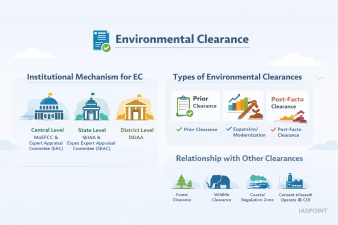
Environmental Clearance is the formal permission granted by the Government of India for the establishment or expansion of specific industrial or infrastructure projects. It is a mandatory requirement under the Environment (Protection) Act, 1986, designed to ensure that proposed activities do not lead to irreparable ecological damage.
Institutional Mechanism for EC
The granting of Environmental Clearance is managed by a multi-tier institutional structure depending on the project’s scale and its potential impact on the environment.
- Central Level: The Ministry of Environment, Forest and Climate Change (MoEFCC) is the nodal agency. It is assisted by the Expert Appraisal Committee (EAC), which consists of professionals and experts who evaluate the EIA reports.
- State Level: The State Environment Impact Assessment Authority (SEIAA) grants clearances for Category B projects. It is assisted by the State Expert Appraisal Committee (SEAC).
- District Level: For specific minor mineral mining projects, the District Environment Impact Assessment Authority (DEIAA) was established, though its powers have been subject to various judicial reviews and NGT orders.
Types of Environmental Clearances
Clearance is required at different stages of a project’s lifecycle to ensure continuous compliance.
- Prior Environmental Clearance: Obtained before any construction work or preparation of land starts (except for securing the land).
- Expansion/Modernization: Required if a project seeks to increase its production capacity or change its product mix beyond the limits specified in the original EC.
- Post-Facto Clearance: A controversial concept where clearance is sought after the project has commenced. The Supreme Court and NGT have generally discouraged this, emphasizing that “environmental rule of law” requires prior assessment.
Categories and Authorities: A Summary Table
| Project Category | Responsibility | Appraisal Body | Requirement |
| Category A | Central Government (MoEFCC) | Expert Appraisal Committee (EAC) | Mandatory EIA & Public Hearing |
| Category B1 | State Government (SEIAA) | State Expert Appraisal Committee (SEAC) | Mandatory EIA |
| Category B2 | State Government (SEIAA) | SEAC (Review only) | No EIA required; follows a simplified process |
The Validity Period of Environmental Clearance
The EC is not permanent; it is granted for a specific duration during which the project construction or activity must be completed.
- River Valley Projects: Valid for 10 years.
- Mining Projects: Valid for the duration of the mining lease, up to a maximum of 30 years.
- Other Projects: Generally valid for 7 years, extendable by a maximum of 3 years based on progress and justification.
Post-Clearance Monitoring and Compliance
Once an EC is granted, the project proponent is legally bound to follow the Environment Management Plan (EMP) and specific conditions laid down in the clearance letter.
- Half-Yearly Compliance Reports: Proponents must submit reports on June 1st and December 1st every year to the regulatory authority, detailing their adherence to the EC conditions.
- Public Disclosure: Compliance reports must be made available on the company’s website and the MoEFCC/SEIAA portals.
- Cancellation of EC: The regulatory authority has the power to cancel or suspend the EC if it is found that the clearance was obtained by concealing facts, submitting false data, or if there is a gross violation of environmental norms.
Relationship with Other Clearances
Environmental Clearance is often part of a “bundle” of approvals required for industrial operations in India.
- Forest Clearance (FC): Required under the Forest (Conservation) Act, 1980, if the project involves the diversion of forest land.
- Wildlife Clearance: Required if the project is located within or near a National Park, Wildlife Sanctuary, or Conservation Reserve.
- Coastal Regulation Zone (CRZ) Clearance: Required for projects in coastal areas to protect the marine ecosystem.
- Consent to Establish (CTE) & Consent to Operate (CTO): Granted by the State Pollution Control Boards under the Air and Water Acts; these are usually applied for after obtaining the EC.
Critical Facts for UPSC Prelims
- The “Six-Month” Rule: Project proponents must submit compliance reports every six months. Failure to do so can lead to a “Non-Compliance” tag and legal action.
- PARIVESH Portal: (Pro-Active and Responsive facilitation by Interactive, Virtuous and Environmental Single-window Hub) is the web-based, role-based workflow application for all clearances (Environment, Forest, Wildlife, and CRZ).
- Exemptions: Projects like minor irrigation tanks, maintenance dredging, and specific strategic defense projects are often exempted from the rigorous EIA/EC process to balance development and national security.
- Public Hearing Exemptions: Projects located within Industrial Estates or Parks that have already received an EC are usually exempt from individual public hearings.