
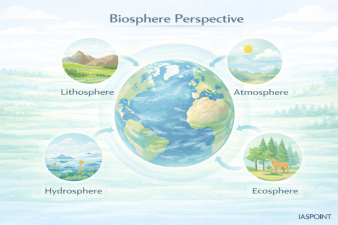
The Biosphere represents the integrated blanket of life on Earth, encompassing all living organisms and their relationships with the lithosphere (rocks), hydrosphere (water), and atmosphere (air). It is a narrow zone where life-sustaining elements overlap, extending roughly from $11,000$ meters below sea level to $10,000$ meters above sea level.
Structural Components of the Biosphere
The biosphere functions through the interaction of three distinct physical domains. Life is generally absent at the extremes of these domains, concentrating instead at their interfaces.
- Abiotic (Physical) Components: These include the lithosphere, atmosphere, and hydrosphere. They provide the inorganic nutrients and physical habitat necessary for life.
- Biotic (Biological) Components: Comprised of producers (autotrophs), consumers (heterotrophs), and decomposers (saprotrophs).
- Energy Component: Solar energy is the primary driver of all biosynthetic processes within the biosphere.
Energy Flow and Nutrient Cycling
The biosphere operates as a closed system for matter but an open system for energy.
1. Unidirectional Energy Flow
Energy enters the biosphere through photosynthesis and moves through various trophic levels.
- Lindeman’s 10% Law: Only about 10% of the energy available at one trophic level is transferred to the next; the rest is lost as heat during respiration and metabolic activities.
- Implication: This limits the number of trophic levels in a food chain (usually 4 to 5).
2. Biogeochemical Cycles (Nutrient Cycling)
Unlike energy, nutrients are recycled within the biosphere.
- Gaseous Cycles: Reservoirs are in the atmosphere or hydrosphere (e.g., Nitrogen, Carbon, Oxygen). These are generally rapid and “perfect” cycles.
- Sedimentary Cycles: Reservoirs are in the Earth’s crust (e.g., Phosphorus, Sulphur). These are slower and more prone to being “locked” in sedimentary rocks for long periods.
Ecological Hierarchy within the Biosphere
The biosphere is organized into a hierarchical structure, moving from the smallest unit to the largest global unit.
| Level | Description |
| Individual | A single living being (e.g., one elephant). |
| Population | A group of individuals of the same species in a given area. |
| Community | Assemblage of populations of different species interacting in an area. |
| Ecosystem | Biological community plus its physical environment (Abiotic + Biotic). |
| Biome | Large regional unit characterized by major vegetation types and climate. |
| Biosphere | The sum of all ecosystems; the “Global Ecosystem.” |
Key Concepts for UPSC Prelims
Biological Magnification (Biomagnification)
The increase in the concentration of persistent, non-biodegradable pollutants (like DDT or Mercury) as one moves up the food chain. This occurs because the pollutant cannot be metabolized or excreted.
Bioaccumulation
The gradual accumulation of a substance, such as a pesticide or other chemical, in an organism. Bioaccumulation occurs within a single organism, whereas biomagnification occurs across trophic levels.
Homeostasis and Feedback Loops
The biosphere maintains a state of equilibrium through self-regulating mechanisms.
- Negative Feedback: Counteracts a change to bring the system back to balance (e.g., increase in CO2 leads to increased plant growth, which eventually lowers CO2).
- Positive Feedback: Accelerates a change, moving the system further from equilibrium (e.g., melting ice reduces albedo, causing more heat absorption and further melting).
Global Conservation Perspectives
The protection of the biosphere is managed through international frameworks, acknowledging that ecosystems do not follow political boundaries.
- UNESCO MAB Programme: The “Man and the Biosphere” programme (started in 1971) promotes the sustainable use and conservation of biological diversity.
- Biosphere Reserves: Large protected areas aimed at conservation, sustainable development, and research.
- Core Area: Strictly protected for nature conservation.
- Buffer Zone: Used for activities compatible with conservation (research, education).
- Transition Area: Area of cooperation where local communities and sustainable resource management coexist.
UPSC Trivia: Gaia Hypothesis
Proposed by James Lovelock, the Gaia Hypothesis suggests that living organisms and their inorganic surroundings evolve as a single, self-regulating system to maintain the conditions for life on Earth. It views the entire Biosphere as a “living organism.”
Last Modified: April 18, 2026