

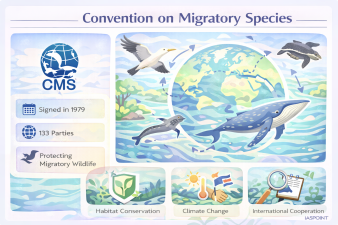
The Convention on the Conservation of Migratory Species of Wild Animals (CMS), also known as the Bonn Convention, is an environmental treaty under the aegis of the United Nations Environment Programme (UNEP). It provides a global platform for the conservation and sustainable use of migratory animals and their habitats.
- Signed: 1979 (Bonn, Germany); In Force: 1983.
- India’s Status: India has been a Party to the CMS since 1983.
- Slogan (COP14): “Nature Knows No Borders.”
- Scope: It is the only global convention specializing in the conservation of migratory species, their habitats, and migration routes across international borders.
Structure of the CMS Appendices
The convention classifies species into two appendices based on the level of protection required.
| Appendix | Conservation Status | Legal Implication |
| Appendix I | Migratory species threatened with extinction. | Parties strive towards strictly protecting these animals, conserving or restoring the places where they live, mitigating obstacles to migration, and controlling other factors that might endanger them. |
| Appendix II | Migratory species that need or would significantly benefit from international co-operation. | Encourages the conclusion of global or regional multilateral agreements (MOUs) for conservation and management. |
Major Outcomes of COP14 (Samarkand, 2024)
The 14th Conference of Parties was a milestone for transboundary conservation, focusing on ecological connectivity.
- Samarkand Strategic Plan (2024–2032): A new framework to guide migratory species conservation in alignment with the Kunming-Montreal Global Biodiversity Framework.
- State of the World’s Migratory Species Report: The first-ever comprehensive assessment revealed that one in five CMS-listed species is threatened with extinction and 97% of listed fish are threatened.
- Species Additions: 14 new species were added, including the Sand Tiger Shark, Magellanic Plover, and the Balkan Lynx.
- Global Partnership on Ecological Connectivity: Launched to ensure that migratory pathways are not fragmented by infrastructure.
Major Outcomes of COP15 (Campo Grande, Brazil, March 2026)
As of early 2026, the CMS has significantly expanded its protective umbrella to address the accelerating biodiversity crisis.
- 40 New Species Listings: COP15 saw a massive expansion with 40 species added or upgraded. Notable additions include the Striped Hyena, Snowy Owl, Giant Otter, and Great Hammerhead Shark.
- Jaguar Conservation: Adoption of the Regional Action Plan for Jaguar Conservation, recognizing its status as a flagship migratory species of the Americas.
- Deep-Sea Mining Moratorium: Parties passed a resolution urging a precautionary approach to deep-sea mining due to its potential impact on marine migratory species.
- Global Assessment of Migratory Freshwater Fishes: Launched to address the drastic decline in inland migratory fish populations.
India’s Leadership and the Central Asian Flyway (CAF)
India has emerged as a “Champion Plus” country under the CMS for its leadership in the Central Asian Flyway.
- Central Asian Flyway (CAF) Initiative: Covering 30 countries from the Arctic to the Indian Ocean, India is leading the establishment of a permanent secretariat and action plan for this bird migratory route.
- National Action Plan for Migratory Birds (2018–2023 & beyond): India has implemented specialized programs to protect species like the Amur Falcon, Great Indian Bustard, and Spoon-billed Sandpiper.
- CMS Champions: India was recognized for its commitment to the “Small Grants Programme” and leadership in regional transboundary conservation.
Legally Binding vs. Non-Binding Agreements
Under Article IV, the CMS facilitates various types of instruments:
- AGREEMENTS: Legally binding treaties (e.g., AEWA – African-Eurasian Waterbird Agreement).
- Memoranda of Understanding (MOUs): Non-binding but highly effective regional cooperation frameworks.
- India is a signatory to: Siberian Crane MOU, Marine Turtles MOU (IOSEA), Dugong MOU, and the Raptors MOU.
Key Trivia for Prelims
- Ecological Connectivity: This is the core theme of current CMS discourse, defined as the “unimpeded movement of species and the flow of natural processes.”
- Appendix I India Examples: Asiatic Lion, Bengal Florican, Great Indian Bustard, and Whale Shark.
- Difference from CITES: While CITES regulates trade of species, CMS focuses on habitat and migration route conservation.
- 2026 Milestone: The 2026 report highlighted that while 20% of species are threatened, proactive “Concerted Actions” have led to a 20% increase in Giraffe populations between 2020 and 2025.