
India remains a global hotspot for botanical research, consistently adding new taxa to its floral inventory. According to the Botanical Survey of India (BSI), hundreds of new plant species, varieties, and records are added annually, primarily from the biodiversity-rich regions of the Western Ghats and the North-East.
- Taxa vs. Species: New discoveries include both “new species” (entirely new to science) and “new records” (species found elsewhere but recorded for the first time within India’s geographical boundaries).
- Major Contributing Regions: The Western Ghats account for nearly 28% of new discoveries, followed by the Eastern Himalayas and the North-East.
Notable Recent Discoveries (2024–2026)
In the last few years, several unique species have been documented that highlight the specific ecological niches of the Indian subcontinent.
| Plant Name | Category / Type | Region Found | Key Features |
| Impatiens tanyae | Balsam (Herb) | Western Ghats (Munnar) | Named after a researcher; features unique pinkish-orange flowers. |
| Salsola oppositifolia | Halophyte (Salt-tolerant) | Kutch, Gujarat | A perennial shrub found in saline desert ecosystems; first record in India. |
| Calanthe tsoongiana | Orchid | Arunachal Pradesh | A terrestrial orchid previously known only from China. |
| Orophea muthabharani | Tree | Wayanad, Kerala | A rare tree species belonging to the custard apple family (Annonaceae). |
| Crepidomanes agasthianum | Fern | Agasthyamala, Kerala | An epiphytic fern found in high-altitude shola forests. |
Protection of Plant Varieties and Farmers’ Rights (PPV&FR) Act, 2001
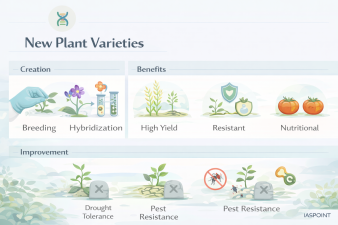
While “new species” are discovered in the wild, “new varieties” often refer to cultivated plants developed through breeding. India has a unique legal framework to protect these.
- Objective: To recognize and protect the rights of farmers and plant breeders and to encourage the development of new varieties of plants.
- DUS Testing: For a variety to be registered, it must pass the DUS Test (Distinctiveness, Uniformity, and Stability).
- Farmers’ Rights: Unlike international systems (UPOV), India’s law allows farmers to save, use, sow, resow, exchange, share, or sell their farm produce, including seeds of a variety protected under the Act (provided they do not sell “branded” seeds).
Categories of Protectable Varieties
- New Varieties: Varieties that are not previously known.
- Extant Varieties: Varieties notified under the Seeds Act, 1966, or those in the common knowledge of farmers.
- Farmers’ Varieties: Varieties traditionally cultivated and developed by farmers in their fields.
- Essentially Derived Varieties (EDV): Varieties derived from an initial variety that retain its essential characteristics.
Taxonomic Infrastructure in India
The discovery and documentation of new plants are supported by a network of herbaria and digital databases.
- Central National Herbarium (CNH): Located in Howrah (Kolkata), it is the largest herbarium in South and South-East Asia, housing over 3 million specimens.
- eFlora of India: A digital initiative by the BSI to provide open access to descriptions and images of all Indian plant species.
- Type Specimen: When a new species is discovered, a “Type Specimen” (Holotype) is deposited in a recognized herbarium to serve as the permanent reference for that name.
Important Facts for UPSC Prelims
- International Plant Names Index (IPNI): A global database that records all new botanical names; Indian discoveries are synchronized with this.
- BSI Publications: The BSI publishes the annual “Plant Discoveries” document, which is a primary source for UPSC environment questions.
- Species vs. Sub-species: A “variety” is a taxonomic rank below species and sub-species, often representing minor morphological differences due to geographical isolation.
- Biodiversity Heritage Sites (BHS): Localities with high floral endemism and new species discoveries can be declared BHS under the Biological Diversity Act, 2002 (e.g., Arittapatti BHS in Tamil Nadu).