
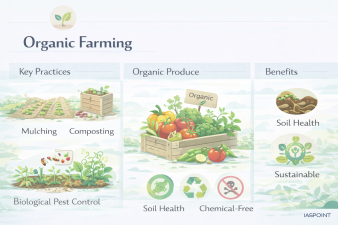
Organic farming is a production system that avoids or largely excludes the use of synthetically compounded fertilizers, pesticides, growth regulators, and livestock feed additives. It relies on crop rotations, crop residues, animal manures, off-farm organic waste, and biological system of nutrient mobilization and plant protection.
Core Principles and Components
The International Federation of Organic Agriculture Movements (IFOAM) defines organic farming based on four principles: Health, Ecology, Fairness, and Care.
- Nutrient Management: Uses Green Manure, Vermicompost, and Bio-fertilizers (Rhizobium, Azotobacter).
- Pest Management: Employs biological control agents (Neem oil, Trichoderma, pheromone traps) and physical barriers.
- Soil Health: Prioritizes “feeding the soil” rather than the plant to maintain long-term fertility and carbon sequestration.
- Zero Synthetic Input: Strict prohibition of Genetically Modified Organisms (GMOs) and chemical urea/phosphates.
Regulatory Framework and Certification in India
India operates two distinct certification systems to cater to both export and domestic markets.
| Feature | APEDA (NPOP) | PGS-India |
| Full Form | National Programme for Organic Production | Participatory Guarantee System |
| Nodal Ministry | Ministry of Commerce and Industry | Ministry of Agriculture & Farmers Welfare |
| Primary Goal | Export-oriented; mandatory for foreign trade | Domestic consumption; local markets |
| Approach | Third-party certification (formal audits) | Peer-group certification (trust-based) |
| Suited for | Large-scale farmers and processors | Small and marginal farmers |
Major Government Initiatives
The Government of India promotes organic farming through targeted schemes to enhance soil health and farmer income.
- Paramparagat Krishi Vikas Yojana (PKVY): A sub-component of the Soil Health Management (SHM) under NMSA. It promotes cluster-based organic farming with PGS certification.
- Mission Organic Value Chain Development for North Eastern Region (MOVCDNER): Specifically targets NE states to develop certified organic production in a value chain mode.
- Bhartiya Prakritik Krishi Paddhati (BPKP): A sub-scheme of PKVY focusing on traditional indigenous practices, emphasizing on-farm input preparation (e.g., Jivamrita).
- Jaivik Kheti Portal: An e-commerce platform and knowledge portal to link organic farmers directly with consumers.
Sikkim: The World’s First Organic State
- In 2016, Sikkim became the first state in the world to become fully organic.
- All agricultural land in the state is certified organic under NPOP.
- The state received the Future Policy Award 2018 from the UN Food and Agriculture Organization (FAO).
Key Concepts and Bio-Inputs
For Prelims, understanding specific traditional formulations is crucial:
- Jivamrita: A fermented microbial culture made from cow dung, urine, jaggery, pulse flour, and soil; acts as a catalytic agent to promote soil microbial activity.
- Bijamrita: Used for seed treatment to protect young roots from fungus and soil-borne diseases.
- Green Manure: Crops like Dhaincha (Sesbania aculeata) or Sunnhemp grown and ploughed into the soil to improve nitrogen content.
Environmental and Economic Impacts
- Carbon Sequestration: Organic soils act as significant carbon sinks, helping mitigate climate change.
- Water Conservation: Organic matter improves soil structure, significantly increasing water-holding capacity and reducing irrigation needs.
- Biodiversity: Eliminates toxic runoff, protecting pollinators (bees) and soil microflora.
- Cost Efficiency: Reduces farmer dependence on expensive external inputs (pesticides/fertilizers), though labor costs may increase.
Trivia for Prelims
- India’s Global Rank: India ranks 1st in terms of the number of organic farmers and 9th in terms of the total area under organic farming (as per 2023-24 data).
- Dharwad Region: Known for the “Dharwad System” of organic waste recycling.
- Bio-pesticide examples: Bacillus thuringiensis (Bt), Pyrethrum (extracted from Chrysanthemum), and Rotenone.