
Glacier retreat in 2026 has transitioned from a gradual environmental shift to an accelerating cryospheric crisis. The Hindu Kush Himalaya (HKH) region, often termed the “Third Pole,” is warming at a rate significantly higher than the global average, leading to profound changes in India’s hydrological and disaster profile.
Status and Rate of Retreat
Recent data from ICIMOD (2026) and ISRO highlight a doubling of ice loss across the Himalayan range compared to previous decades.
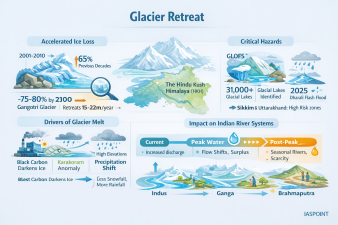
- Accelerated Volume Loss: The HKH region lost approximately 65% more ice between 2011–2020 than in the previous decade. Projections for 2026 suggest that up to 75-80% of glacier volume could be lost by 2100 under current warming trajectories.
- The Gangotri Case Study: India’s largest glacier, Gangotri, has been retreating at a rate of roughly 15–22 meters per year. A 2025 study revealed it has lost 10% of its snowmelt flow since the 1980s, shifting the peak discharge month from August to July.
- The Karakoram Anomaly: Unlike the rest of the Himalayas, parts of the Karakoram range have shown stability or marginal mass gain. However, 2026 observations indicate this “anomaly” is weakening as regional temperatures continue to rise.
Primary Drivers of Glacier Melt
While global temperature rise is the overarching cause, localized factors in South Asia significantly accelerate the process.
- Black Carbon Deposition: Soot from incomplete combustion (biomass burning, vehicle emissions in the Indo-Gangetic Plains) settles on glacier surfaces. This reduces the Albedo effect (reflectivity), causing the ice to absorb more solar radiation and melt faster.
- Elevation-Dependent Warming (EDW): High-altitude regions are warming faster than the plains, a phenomenon that exacerbates the melting of “clean” ice at higher elevations.
- Precipitation Shift: There is a documented shift from snowfall to rainfall at high altitudes. Rain adds thermal energy to the glacier surface, further accelerating the “melting-from-above” process.
Critical Hazards: GLOFs and Ice Collapses
The retreat of glaciers creates immediate and catastrophic secondary hazards.
- Glacial Lake Outburst Floods (GLOFs): As glaciers shrink, they leave behind depressions filled with meltwater, dammed only by unstable debris (moraines).
- 2026 Status: Over 31,000 glacial lakes are growing across High Mountain Asia.
- Indian Vulnerability: Sikkim (South Lhonak Lake) and Uttarakhand remain high-risk zones. The National GLOF Management Project (2026) has identified 195 high-risk lakes for priority monitoring.
- Ice-Patch Collapses: A new category of disaster identified in 2025 (Dharali flash flood) involves the collapse of exposed ice patches in nivation hollows, proving that even small, non-lake-forming ice bodies pose significant risks to downstream villages.
Long-term Impact on Indian River Systems
The Himalayas feed the Indus, Ganga, and Brahmaputra basins, which support nearly 500 million people.
| Phase | Impact on River Flow | Outcome |
| Current (Short-term) | Increased discharge due to rapid melt. | Frequent flash floods; high sediment load; hydropower damage. |
| “Peak Water” (Mid-term) | The point where meltwater reaches its maximum volume. | Temporary surplus; risk of river course shifting. |
| Post-Peak (Long-term) | Drastic decline in base flows (dry season flow). | Perennial rivers becoming seasonal; severe water/food insecurity. |
Policy and Monitoring Framework (2026)
India has enhanced its cryospheric governance through technology and multilateralism.
- International Year of Glaciers’ Preservation (2025): Led to the UN declaring 2025–2034 as the Decade of Action on Cryospheric Science.
- National Mission for Sustaining the Himalayan Ecosystem (NMSHE): A key pillar of the NAPCC focusing on glaciology and community resilience.
- ISRO Satellite Monitoring: Use of RISAT and Cartosat for real-time monitoring of over 9,500 Himalayan glaciers and automated GLOF early warning systems.
UPSC Trivia: Glaciology Facts
- Cryospheric Squeeze: The reduction of habitat for high-altitude species (e.g., Snow Leopard) as the snow line moves higher.
- Firn: The intermediate stage between snow and glacial ice; its thinning is a primary indicator of a “stressed” glacier.
- Third Pole Council: A proposed multilateral body (India, China, Nepal, etc.) discussed in 2026 to share hydrological data on transboundary glaciers.