
Net Zero, also referred to as carbon neutrality, is a state in which the greenhouse gases (GHGs) going into the atmosphere are balanced by removal out of the atmosphere. Achieving Net Zero is considered the primary goal for stabilizing global temperatures and preventing the most catastrophic effects of climate change.
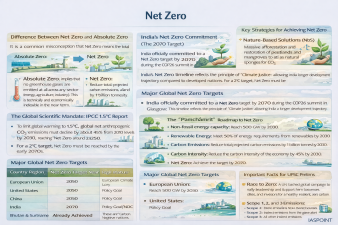
Difference Between Net Zero and Absolute Zero
It is a common misconception that Net Zero means the total cessation of all emissions.
- Absolute Zero: Implies that no greenhouse gases are emitted at all across any sector (energy, agriculture, industry). This is technically and economically unfeasible in the near term.
- Net Zero: Recognizes that some sectors (like aviation or heavy industry) will have “residual emissions.” These are balanced by “removals” such as afforestation or Carbon Capture and Storage (CCS).
The Global Scientific Mandate: IPCC 1.5°C Report
The Intergovernmental Panel on Climate Change (IPCC) states that to limit global warming to 1.5°C, global net anthropogenic CO2 emissions must decline by about 45% from 2010 levels by 2030, reaching Net Zero around 2050. For a 2°C target, Net Zero must be reached by the early 2070s.
India’s Net Zero Commitment (The 2070 Target)
India officially committed to a Net Zero target by 2070 during the COP26 summit in Glasgow. This timeline reflects the principle of “Climate Justice,” allowing India a longer development trajectory compared to developed nations.
The “Panchamrit” Roadmap to Net Zero
To reach the 2070 goal, India defined five nectar elements (Panchamrit):
- Non-fossil energy capacity: Reach 500 GW by 2030.
- Renewable Energy: Meet 50% of energy requirements from renewables by 2030.
- Carbon Emissions: Reduce total projected carbon emissions by 1 billion tonnes by 2030.
- Carbon Intensity: Reduce the carbon intensity of the economy by 45% by 2030.
- Net Zero: Achieve the target by 2070.
Key Strategies for Achieving Net Zero
Reaching Net Zero requires a systemic overhaul of the economy, categorized into “Decarbonization” and “Carbon Removal.”
Decarbonization (Reducing Inflow)
- Electrification: Shifting fossil-fuel-based processes to electricity (e.g., Electric Vehicles, Induction heating in industry).
- Green Hydrogen: Using hydrogen as a fuel and feedstock for “hard-to-abate” sectors like steel, cement, and chemicals.
- Energy Efficiency: Reducing the amount of energy required to provide products and services.
Carbon Removal (Increasing Outflow)
- Nature-Based Solutions (NbS): Massive afforestation and restoration of peatlands and mangroves to act as natural sponges for CO2.
- Technical Removal: Deploying Direct Air Capture (DAC) and Bioenergy with Carbon Capture and Storage (BECCS).
Major Global Net Zero Targets
| Country/Region | Net Zero Target Year | Legal Status |
| European Union | 2050 | European Climate Law |
| United States | 2050 | Policy Goal |
| China | 2060 | Policy Goal |
| India | 2070 | Policy Goal/NDC |
| Bhutan & Suriname | Already Achieved | These are “Carbon Negative” nations. |
Challenges in the Path to Net Zero
- Financial Gap: The transition requires trillions of dollars in investment. Developing nations lack the fiscal space to fund this without international support.
- Technology Readiness: Technologies like Green Hydrogen and CCS are currently expensive and not yet available at a commercial scale in many regions.
- Just Transition: Moving away from coal impacts millions of livelihoods in regions like India’s “coal belt” (Jharkhand, Chhattisgarh, Odisha).
- Critical Minerals: The shift to renewables requires massive amounts of lithium, cobalt, and rare earth elements, raising concerns about supply chain security and mining ethics.
Important Facts for UPSC Prelims
- Race to Zero: A UN-backed global campaign to rally leadership and support from businesses, cities, and investors for a healthy, resilient, zero-carbon recovery.
- Scope 1, 2, and 3 Emissions: * Scope 1: Direct emissions from owned sources.
- Scope 2: Indirect emissions from the generation of purchased energy.
- Scope 3: All other indirect emissions in a company’s value chain (hardest to track).
- Carbon Border Adjustment Mechanism (CBAM): A EU policy that puts a carbon price on imports of carbon-intensive goods, pressuring trading partners to adopt Net Zero targets.
- Methane vs. CO2: While Net Zero often focuses on CO2, the “Net Zero” goal under the Paris Agreement technically covers all GHGs. However, some countries specify “Carbon Neutrality” (only CO2) versus “GHG Neutrality” (all gases).