
India is one of the 17 mega-biodiverse countries, harboring approximately 7% to 8% of the world’s recorded species. Within its diverse agro-climatic zones, over 8,000 species of medicinal plants are utilized in traditional systems of medicine, including Ayurveda, Siddha, Unani, and Sowa Rigpa.
Institutional Framework and Governance
The regulation and promotion of medicinal plants in India are managed through specialized bodies and legislative acts to prevent over-exploitation and bio-piracy.
National Medicinal Plants Board (NMPB)
- Status: A statutory body established in 2000 under the Ministry of AYUSH.
- Mandate: Coordinates all matters related to medicinal plants, including conservation, cultivation, and export promotion.
- e-CHARAK: A web portal and mobile application launched by NMPB to facilitate the marketing and trade of medicinal plants and herbs.
- Arogya Van Initiative: A recent project (2026) focusing on thematic plantations of medicinal tree species along National Highways to create green corridors and support pollinators.
Traditional Knowledge Digital Library (TKDL)
- Origin: Joint initiative of CSIR and the Ministry of AYUSH.
- Purpose: A digital repository of Indian traditional medicinal knowledge (Ayurveda, Unani, Siddha, Yoga) translated into five international languages (English, French, German, Spanish, and Japanese).
- Role in IPR: Acts as a “prior art” database to prevent the grant of “wrong” patents on Indian traditional knowledge by international patent offices.
Key Medicinal Plants and IUCN Status
Several Himalayan and peninsular medicinal plants are currently facing extinction due to over-harvesting and climate-induced habitat shifts.
| Plant Name (Common/Scientific) | IUCN Red List Status | Major Therapeutic Uses |
| Meizotropis pellita (Patwa) | Critically Endangered | Shrub endemic to Uttarakhand; used for local medicinal purposes. |
| Dactylorhiza hatagirea (Salam Panja) | Endangered | Used to treat dysentery, gastritis, and chronic fever. |
| Fritillaria cirrhosa (Himalayan Fritillary) | Vulnerable | Strong cough suppressant; used for bronchial disorders. |
| Nardostachys jatamansi (Jatamansi) | Critically Endangered | Used for treating epilepsy, hysteria, and heart palpitations. |
| Taxus wallichiana (Himalayan Yew) | Endangered | Source of Taxol (anti-cancer drug); also used in Unani as a sedative. |
| Pterocarpus santalinus (Red Sanders) | Endangered | Used for skin disorders and as a source of red dye (Endemic to Eastern Ghats). |
| Rauvolfia serpentina (Sarpagandha) | Endangered | Treatment of hypertension and various central nervous disorders. |
Major Medicinal Plants and Their Applications
The following species are frequently cited in environmental and health contexts due to their wide-ranging applications and economic value.
Ashwagandha (Withania somnifera)
- Known as “Winter Cherry” or “Indian Ginseng.”
- Uses: Primarily an adaptogen used for stress management, immunity boosting, and anti-inflammatory properties.
- Conservation: Widely cultivated; identified as a priority species for the NMPB consortia.
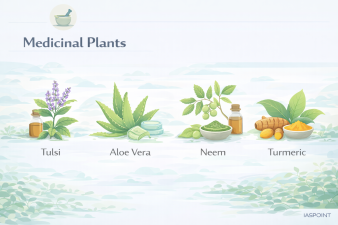
Neem (Azadirachta indica)
- Known as the “Village Pharmacy.”
- Uses: Potent antiseptic, antifungal, and antibacterial properties. Used in “Neem Coated Urea” to prevent nitrogen leaching in agriculture.
- Trivia: India won a landmark legal battle against a US patent on Neem’s antifungal properties by proving “prior art.”
Tulsi (Ocimum sanctum)
- Commonly referred to as “Holy Basil.”
- Uses: Respiratory relief (cough, cold), digestive health, and as an antioxidant.
- Significance: Integral to the Indian household and the Ayurvedic “Rasayana” category for longevity.
Amla (Phyllanthus emblica)
- Uses: Richest natural source of Vitamin C. Used in Chyawanprash for immunity and for treating jaundice and indigestion.
- Geographic spread: Found across tropical and subtropical India.
Threats and Conservation Challenges
The medicinal plant sector faces several ecological and regulatory hurdles that are critical for Prelims questions on environmental degradation.
- Over-exploitation: Approximately 90% of medicinal plants used by the Indian industry are collected from the wild, leading to the depletion of genetic stocks.
- Climate Change: Research in 2026 indicates an upward altitudinal shift of alpine medicinal plants in the Himalayas (up to 6.95 m/year) due to rising temperatures, leading to “habitat squeeze.”
- Bio-piracy: Unauthorized appropriation of biological resources and traditional knowledge by commercial entities without fair compensation to indigenous communities.
- Habitat Fragmentation: Infrastructure projects in biodiversity hotspots like the Western Ghats and Himalayas disrupt the micro-climates necessary for specialized medicinal flora.
Key Government Schemes and Initiatives
- National Mission on Medicinal Plants: A centrally sponsored scheme under the National Ayush Mission (NAM).
- Biological Diversity Act, 2002: Implemented through the National Biodiversity Authority (NBA); mandates “Access and Benefit Sharing” (ABS) for using biological resources.
- Mission for Integrated Development of Horticulture (MIDH): Provides financial assistance for the cultivation of non-perennial medicinal plants.
- Conservation Initiatives: In-situ conservation through Medicinal Plants Conservation Areas (MPCAs) and ex-situ conservation through herbal gardens and gene banks.