

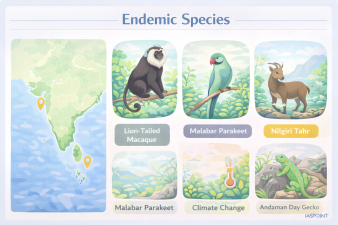
Endemism refers to the ecological state of a species being unique to a defined geographic location, such as a specific island, habitat type, nation, or other defined zone. To be endemic to a place, an organism must be found naturally only in that area and nowhere else on Earth. This concept is a critical metric for identifying “Biodiversity Hotspots.”
Classifications of Endemic Species
Endemic species are categorized based on their evolutionary history and the time they have spent in a specific region:
- Paleoendemics: These are “relict” species that were once widespread but are now restricted to a small area due to environmental changes or extinction elsewhere (e.g., Ginkgo biloba).
- Neoendemics: These are recently evolved species that have not yet had the time or opportunity to expand their range beyond their place of origin (e.g., many species of Cichlid fish in African lakes).
Factors Influencing Endemism in India
The high degree of endemism in the Indian subcontinent is driven by several geographical and biological factors:
- Geographical Barriers: The Himalayan mountain range in the north and the Indian Ocean on three sides act as physical barriers, preventing species migration and promoting localized evolution.
- Varied Biogeographic Zones: India is divided into 10 distinct biogeographic zones (Trans-Himalaya, Himalaya, Desert, Semi-arid, Western Ghats, Deccan Peninsula, Gangetic Plain, North-East India, Islands, and Coasts), each providing unique niches.
- Climatic Gradients: Significant variations in rainfall (from the Thar desert to Mawsynram) and altitude create specialized micro-habitats.
Major Endemic Mammals of India
India hosts approximately 39+ endemic mammal species, primarily concentrated in the Western Ghats and North-East India.
| Species Name | Native Region | IUCN Status (2025-26) | Key Fact |
| Asiatic Lion | Gir Forest, Gujarat | Endangered | Only found in the Saurashtra region. |
| Lion-tailed Macaque | Western Ghats | Endangered | Recognizable by its silver-white mane. |
| Nilgiri Tahr | Western Ghats | Endangered | State animal of Tamil Nadu; inhabits shola grasslands. |
| Sangai (Brow-antlered Deer) | Keibul Lamjao, Manipur | Critically Endangered | Inhabits the “Phumdis” (floating marshes) of Loktak Lake. |
| Kashmir Stag (Hangul) | Dachigam NP, J&K | Critically Endangered | Only surviving species of the Red Deer family in India. |
| Pygmy Hog | Manas NP, Assam | Critically Endangered | World’s smallest and rarest wild canid/pig. |
| Malabar Large-spotted Civet | Western Ghats | Critically Endangered | One of the world’s rarest mammals; elusive. |
Significant Endemic Birds and Reptiles
Endemism is particularly high among birds (72+ species) and amphibians/reptiles in the island territories and mountain ranges.
Endemic Avifauna
- Narcondam Hornbill: Restricted to the tiny Narcondam Island in the Andamans. (Endangered)
- Great Indian Bustard: Endemic to the dry grasslands of Rajasthan and Gujarat. (Critically Endangered)
- Forest Owlet: Found in the dry deciduous forests of Central India (Satpura Range). (Endangered)
- Bugun Liocichla: Found only in the Eaglenest Wildlife Sanctuary, Arunachal Pradesh.
Endemic Reptiles and Amphibians
- Purple Frog (Pignose Frog): Found in the Western Ghats; spends most of its life underground.
- Red-crowned Roofed Turtle: Endemic to the freshwater systems of the Gangetic basin.
- Gharial: While found in Nepal, it is largely endemic to the deep flowing rivers of the National Chambal Sanctuary.
Notable Endemic Flora
India’s botanical endemism is highest in the Western Ghats (approx. 56% of plants there are endemic) and the Eastern Himalayas.
| Plant Name | Region | Significance |
| Neelakurinji | Western Ghats | Famous for blooming once every 12 years. |
| Red Sanders | Seshachalam Hills, AP | High-value timber; listed as Endangered. |
| Indian Pitcher Plant | Khasi Hills, Meghalaya | Only carnivorous pitcher plant native to India. |
| Cycas beddomei | Andhra Pradesh | A medicinal gymnosperm found in the Cuddapah hills. |
Threats and Conservation Challenges
Due to their restricted range, endemic species are highly susceptible to:
- Habitat Fragmentation: Linear infrastructure (roads, dams) breaks the narrow range required for breeding.
- Invasive Alien Species: Species like Lantana camara or African Catfish outcompete localized endemics.
- Climate Change: High-altitude endemics (like the Himalayan Tahr) face “mountain-top extinction” as they cannot migrate further up when temperatures rise.
- Anthropogenic Pressure: Specialized endemics often have low reproductive rates, making them unable to recover quickly from poaching or habitat loss.
Key Trivia for Prelims
- Hotspot Criteria: To qualify as a Biodiversity Hotspot, a region must contain at least 1,500 species of vascular plants (> 0.5% of the world’s total) as endemics.
- Island Endemism: The Andaman and Nicobar Islands show the highest percentage of endemism relative to land area in India.
- The “Hoolock Gibbon”: It is the only ape found in India, endemic to the North-East forests south of the Brahmaputra.