
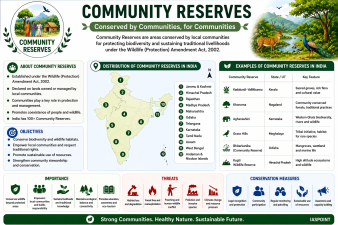
Community Reserves are a category of protected areas in India established under the Wildlife (Protection) Amendment Act, 2002, which amended the original 1972 Act. They were introduced to provide a legal recognition to conservation efforts initiated by local communities and individuals on non-government lands.
- Legal Provision: Notified under Section 36C of the Wildlife (Protection) Act, 1972.
- Land Ownership: Unlike Conservation Reserves (government land), Community Reserves are established on private or community lands.
- Voluntary Nature: The declaration is made by the State Government only after the community or individual volunteers to conserve wildlife and its habitat.
Governance and Management Structure
The management of Community Reserves is designed to be decentralized, ensuring that the primary custodians of the land retain a significant voice in its administration.
- Community Reserve Management Committee: Under Section 36D, the State Government constitutes a committee responsible for managing and maintaining the reserve.
- Composition: The committee consists of five representatives nominated by the Village Panchayat (or Gram Sabha) and one representative from the State Forest Department.
- Authority: The committee serves as the decision-making body for the conservation of the area, though the Chief Wildlife Warden of the state retains overall supervisory authority.
Regional Distribution and Statistics
As of early 2026, there are over 220 Community Reserves in India. The distribution is highly skewed, with the majority located in North-Eastern India, where community-owned forests are prevalent.
| State | Prominent Examples | Ecological Significance |
| Meghalaya | Khasihill Community Reserves | Protects sacred groves and rare orchids; Meghalaya has the highest number of Community Reserves. |
| Punjab | Keshopur-Chamb Community Reserve | India’s first notified Community Reserve; a critical migratory bird habitat and Ramsar site. |
| Nagaland | Khonoma Nature Conservation | Famous for the conservation of the Blyth’s Tragopan (vulnerable pheasant). |
| Rajasthan | Gogelav Community Reserve | Focuses on the conservation of Chinkaras and desert flora. |
| Haryana | Tila Yar Community Reserve | Established to protect local wetland biodiversity and small mammals. |
Rights and Restrictions
A common point of confusion for aspirants is the status of human activity within these zones.
- No Change in Land Use: Once an area is notified as a Community Reserve, no change in land use pattern is allowed within the reserve, except for the improvement of habitat or with the consent of the Management Committee.
- Traditional Rights: Traditional practices like sustainable grazing or collection of minor forest produce are generally allowed if they were part of the community’s lifestyle prior to notification.
- Prohibition of Hunting: All forms of hunting are strictly prohibited under the Wildlife (Protection) Act within the boundaries of the reserve.
Ecological and Social Significance
- Recognition of Sacred Groves: Many Community Reserves are built around ancient “Sacred Groves,” providing legal protection to traditional ethno-forestry practices.
- Protection of Corridors: They often act as vital stepping stones for wildlife moving between larger National Parks, especially in fragmented landscapes.
- Conflict Resolution: By giving legal status to community efforts, it reduces the friction between the Forest Department and local residents, fostering a partnership model of conservation.
Important Trivia for UPSC Prelims
- First Community Reserve: The Keshopur-Chamb Community Reserve in Gurdaspur, Punjab, holds the distinction of being the first of its kind in India.
- North-East Dominance: Over 90% of India’s Community Reserves are located in the North-Eastern states, specifically Meghalaya and Nagaland, due to unique land tenure systems where tribes own the forest land.
- Section 36D(2): This specific clause mandates that the Management Committee shall also be the authority to regulate the use of water and grazing within the reserve.
- The “Khonoma Model”: The Khonoma village in Nagaland is globally cited as a success story where a hunting-dependent community transitioned into a leading conservationist group, eventually leading to the creation of a Community Reserve.