
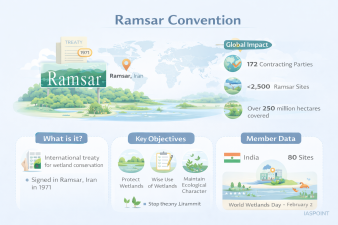
The Convention on Wetlands, commonly known as the Ramsar Convention, is an intergovernmental treaty that provides the framework for national action and international cooperation for the conservation and wise use of wetlands and their resources. It is the only global environmental treaty that deals with a particular ecosystem.
Key Historical and Legal Facts
- Adoption: Signed on February 2, 1971, in the Iranian city of Ramsar, on the shores of the Caspian Sea.
- Enforcement: It came into force in 1975.
- Status in India: India signed the convention on February 1, 1982.
- Legal Nature: The convention is not part of the United Nations system of Multilateral Environmental Agreements (MEAs), but it works closely with UN bodies.
- Three Pillars of the Convention:
- Work towards the Wise Use of all their wetlands.
- Designate suitable wetlands for the list of Wetlands of International Importance (Ramsar Sites).
- Cooperate internationally on transboundary wetlands and shared species.
The Concept of “Wise Use”
The “Wise Use” concept is at the heart of the Ramsar Convention. It is defined as “the maintenance of their ecological character, achieved through the implementation of ecosystem approaches, within the context of sustainable development.” This allows for human use of wetlands as long as it does not degrade the ecosystem’s integrity.
The Montreux Record
The Montreux Record is a register of wetland sites on the List of Wetlands of International Importance where changes in ecological character have occurred, are occurring, or are likely to occur as a result of technological developments, pollution, or other human interference.
- India’s Sites in Montreux Record: Currently, two sites are listed: Keoladeo National Park (Rajasthan) and Loktak Lake (Manipur).
- Success Story: Chilika Lake (Odisha) was placed on the record in 1993 but removed in 2002 following successful restoration efforts, making it the first site from Asia to be removed from the list.
Criteria for Designation as a Ramsar Site
A wetland is identified as being of international importance if it meets at least one of the nine specific criteria:
- Representative/Unique Wetland: Contains a representative, rare, or unique example of a natural or near-natural wetland type.
- Vulnerable Species: Supports vulnerable, endangered, or critically endangered species or threatened ecological communities.
- Biological Diversity: Supports populations of plant and/or animal species important for maintaining the biological diversity of a particular biogeographic region.
- Critical Life Stage: Supports species at a critical stage in their life cycles or provides refuge during adverse conditions.
- Waterbirds (20,000): Regularly supports 20,000 or more waterbirds.
- Waterbirds (1%): Regularly supports 1% of the individuals in a population of one species or subspecies of waterbird.
- Fish Diversity: Supports a significant proportion of indigenous fish subspecies, species, or families.
- Fish Spawning Ground: Is an important source of food for fishes, spawning ground, nursery, and/or migration path.
- Non-Avian Taxa: Regularly supports 1% of the individuals in a population of one species or subspecies of wetland-dependent non-avian animal species.
Important Ramsar Facts for UPSC
| Attribute | Statistic/Detail |
| Number of Ramsar Sites in India | 85 (As of 2024) |
| State with maximum Ramsar Sites | Tamil Nadu (16 sites) |
| State with second highest sites | Uttar Pradesh (10 sites) |
| Largest Ramsar Site in India | Sundarbans Wetland (West Bengal) |
| Smallest Ramsar Site in India | Renuka Wetland (Himachal Pradesh) |
| Oldest Ramsar Sites (India) | Chilika Lake and Keoladeo National Park (1981) |
| Country with most Ramsar Sites | United Kingdom (175 sites) |
| Country with largest area under Ramsar | Bolivia |
Notable Recent Additions to India’s List (2024)
- Ankasamudra Bird Conservation Reserve (Karnataka)
- Aghanashini Estuary (Karnataka)
- Magadi Kere Conservation Reserve (Karnataka)
- Karaivetti Bird Sanctuary (Tamil Nadu)
- Longwood Shola Reserve Forest (Tamil Nadu)
Institutional Support: International Organization Partners (IOPs)
The Convention works with six international non-governmental organizations as IOPs:
- BirdLife International
- IUCN (International Union for Conservation of Nature)
- IWMI (International Water Management Institute)
- Wetlands International
- WWF International
- Wildfowl & Wetlands Trust (WWT)