

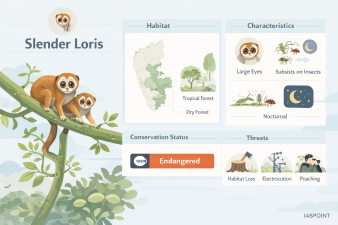
The Slender Loris (Loris tardigradus and Loris lydekkerianus) is a small, nocturnal primate endemic to India and Sri Lanka. Known for its large, soulful eyes and thin, spindly limbs, it is a prosimian (a group of primates that includes lemurs and tarsiers). In India, it is primarily found in the tropical rainforests and scrub forests of the Southern Western Ghats and Eastern Ghats.
Taxonomic Classification and Species in India
There are two distinct species of Slender Loris, with various subspecies.
- Red Slender Loris (Loris tardigradus): Endemic to Sri Lanka.
- Grey Slender Loris (Loris lydekkerianus): Found in both India and Sri Lanka.
- Malabar Slender Loris: Found in the wet forests of the Western Ghats.
- Mysore Slender Loris: Found in the drier scrub forests of Karnataka and Tamil Nadu.
Physical and Behavioral Characteristics
- Nocturnality: They are strictly nocturnal, waking up at dusk to hunt. Their large eyes have a reflective layer called the tapetum lucidum, which enhances night vision.
- Movement: They are slow, deliberate climbers. Unlike many primates, they do not leap; they maintain at least three points of contact with branches while moving.
- Diet: Primarily insectivorous. They are known for their ability to eat “toxic” insects like fire ants and poisonous beetles that other animals avoid. They also consume lizards, bird eggs, and fruits.
- Social Structure: While they forage alone, they are social animals that sleep in groups (communal sleeping) in hollow trees or thickets.
Conservation Status and Legal Protection
The Slender Loris is a “low-profile” but ecologically significant species that has recently gained legal and administrative attention in India.
| Framework | Status/Category |
| IUCN Red List | Endangered (Red Slender Loris) / Near Threatened (Grey Slender Loris) |
| Wildlife Protection Act, 1972 | Schedule I (Highest Protection) |
| CITES | Appendix II |
India’s First Slender Loris Sanctuary
In 2022, the Tamil Nadu government notified the Kadavur Slender Loris Sanctuary, marking a significant milestone in the conservation of this species.
- Location: Spans the Karur and Dindigul districts of Tamil Nadu.
- Significance: It protects the scrub forests that serve as a critical habitat for the Grey Slender Loris.
- Ecological Role: By feeding on pests that damage agricultural crops, the Loris acts as a natural biological control agent for local farmers.
Major Threats to Survival
- Habitat Loss: Fragmentation of forests due to expanding agriculture and grazing.
- Superstition and Illegal Trade: They are often captured for use in “black magic” or traditional medicine due to their unique appearance.
- Roadkills: As nocturnal animals, they are frequently blinded by vehicle headlights while crossing roads that bisect their forest homes.
- Pesticides: The heavy use of chemical pesticides reduces their primary food source (insects) and leads to secondary poisoning.
Comparison: Slender Loris vs. Slow Loris
For UPSC Prelims, it is vital to distinguish between the two types of Lorises found in India.
| Feature | Slender Loris | Slow Loris (Nycticebus) |
| Regional Range | South India (Western/Eastern Ghats) | Northeast India |
| Build | Spindly, very thin limbs | Robust, stout body |
| Venom | Not venomous | Venomous (toxic brachial gland) |
| Tail | Absent/Vestigial | Short/Vestigial |
Trivia and Key Facts for Prelims
- Urine Washing: They engage in a behavior called “urine washing,” where they wash their hands and feet in their own urine. This is believed to help in scent marking and improving grip on branches.
- Arboreal Nature: They spend almost their entire lives in trees and rarely descend to the forest floor.
- Indicator Species: Their presence is a sign of a healthy, pesticide-free scrub forest or rainforest ecosystem.
- Ecology: They are among the few primates that have adapted to live in both dense evergreen forests and dry, thorny scrub jungles.