
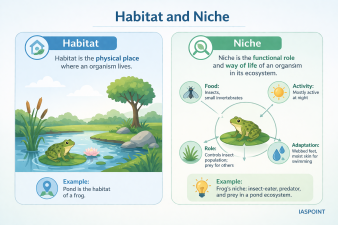
In ecological studies, understanding where an organism lives and what it does is fundamental. While often used interchangeably in common parlance, “Habitat” and “Niche” represent distinct ecological dimensions. A habitat is the physical environment, whereas a niche is the functional role within that environment.
1. Habitat: The Ecological Address
A habitat is the specific physical place or locality where an organism lives. It provides the essential requirements for survival: food, water, shelter, and space.
Features of Habitat
- Scale: Habitats can be vast (an ocean) or microscopic (the gut of a termite).
- Multi-species Presence: A single habitat can support numerous species simultaneously (e.g., a tropical rainforest supports monkeys, birds, insects, and fungi).
- Physicality: Defined primarily by abiotic factors like temperature, soil type, moisture, and sunlight.
Types of Habitats
- Terrestrial: Forests, grasslands, deserts, and mountains.
- Freshwater: Rivers, lakes, and wetlands.
- Marine: Coral reefs, deep-sea vents, and estuaries.
2. Ecological Niche: The Ecological Profession
The term “Niche” was first coined by Joseph Grinnell and later refined by Charles Elton and G.E. Hutchinson. It describes the total range of physical and biological conditions under which a species can survive and the functional role it plays in the ecosystem.
Dimensions of a Niche
- Habitat Niche: Where the species lives.
- Food Niche: What it eats, what it competes with, and its position in the food web.
- Reproductive Niche: How and when it reproduces.
- Physical & Chemical Niche: Tolerance limits for temperature, land shape, land slope, humidity, and other factors.
3. Key Niche Principles
Competitive Exclusion Principle (Gause’s Law)
This principle states that two species competing for the same limiting resources cannot coexist at constant population values. One will always have a slight advantage over the other, leading to the extinction or evolutionary shift of the less fit species.
Niche Partitioning (Resource Partitioning)
To avoid direct competition and coexist, species often evolve to use different resources or the same resource at different times or in different ways.
- Example: Different species of warblers (birds) feeding on different parts of the same tree.
Fundamental vs. Realized Niche
- Fundamental Niche: The full potential range of conditions and resources a species could theoretically use in the absence of competition and predation.
- Realized Niche: The actual range of conditions and resources a species uses, restricted by the presence of other species (competition/predation).
4. Comparison: Habitat vs. Niche
| Feature | Habitat | Niche |
| Definition | The physical place where an organism lives. | The functional role and position of a species. |
| Component | Primarily abiotic (physical) factors. | Biotic and abiotic interactions. |
| Specificity | Multiple species can share the same habitat. | No two species can occupy the exact same niche. |
| Example | A forest is a habitat. | A woodpecker’s role as an insectivore in the forest canopy. |
5. Significance of Niche in Ecosystems
- Biodiversity: A habitat with many diverse niches can support higher biodiversity.
- Stability: If a niche becomes vacant due to extinction, the ecosystem may become unstable until another species fills that functional role.
- Evolution: Niche specialization leads to morphological and behavioral changes over generations, driving speciation.
6. Trivia and UPSC Facts
- Generalist Species: Species with broad niches that can live in many different places and eat a variety of foods (e.g., Crows, Rats, Humans).
- Specialist Species: Species with narrow niches that require specific habitats or food sources (e.g., Giant Panda which eats primarily bamboo). These are more prone to extinction.
- Ecological Equivalents: Species that occupy similar niches but live in different geographical regions (e.g., the kangaroo in Australia and the bison in North America, both being large grassland herbivores).