
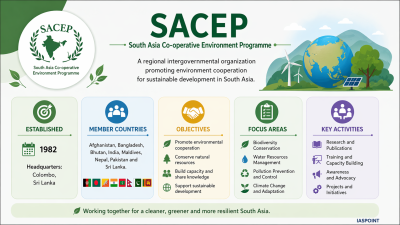
SACEP is an intergovernmental organization established in 1982 to promote regional cooperation in South Asia for the protection, management, and enhancement of the environment. It serves as a vital platform for addressing transboundary environmental issues that impact the eight member nations.
Institutional Profile and Governance
Foundation and Structure
- Establishment: Created in 1982 following the Colombo Declaration (1981).
- Headquarters: Colombo, Sri Lanka.
- Legal Basis: The Articles of Association of SACEP constitute its legal framework.
- Member Countries: Afghanistan, Bangladesh, Bhutan, India, Maldives, Nepal, Pakistan, and Sri Lanka.
Governance Organs
- Governing Council (GC): The principal deliberative and review body, consisting of Ministerial-level representatives from member states. It meets annually to determine policy.
- Consultative Committee (CC): Comprised of the diplomatic representatives of member states based in Colombo; it facilitates the implementation of GC decisions.
- Secretariat: Headed by a Director General, it provides administrative and technical support for the work program.
Major Regional Programmes and Actions
South Asian Seas Programme (SASP)
One of the 18 Regional Seas Programmes of the United Nations Environment Programme (UNEP). SACEP serves as the Secretariat for SASP.
- Member States: Bangladesh, India, Maldives, Pakistan, and Sri Lanka (the five maritime nations).
- Focus: Protection of marine and coastal ecosystems, addressing oil spills, and managing coral reef health.
- Action Plan: The South Asian Seas Action Plan (SASAP) was adopted in 1995 in New Delhi.
Malé Declaration on Air Pollution
Adopted in 1998 at the 7th Governing Council meeting in Malé, Maldives.
- Objective: To control and prevent transboundary air pollution and its likely effects in South Asia.
- Phased Approach: Focuses on capacity building, monitoring pollutant gases, and developing national action plans to mitigate acid deposition and health impacts.
Key Projects and Recent Initiatives (2020–2026)
| Project / Initiative | Description | Partnership |
| PLEASE Project | Plastic-free Rivers and Seas for South Asia. Aimed at reducing plastic pollution and promoting a circular economy. | World Bank (IDA) & Parley for the Oceans. |
| South Asia Nitrogen Hub (SANH) | Researching the impact of nitrogen pollution on the environment and developing seawater quality criteria. | UK Research and Innovation (UKRI). |
| Oil Spill Contingency Plan | A regional framework for cooperation in response to large-scale oil and chemical spills in the South Asian Seas. | International Maritime Organization (IMO). |
| GloFouling Project | Addressing the transfer of invasive aquatic species through biofouling on ships. | IMO & GEF. |
SACEP Strategy 2020–2030
The current roadmap for the decade focuses on six “Priority Intervention Areas”:
- Waste Management: Emphasizing plastic waste and electronic waste (e-waste).
- Climate Change: Enhancing regional adaptation and resilience.
- Biodiversity Restoration: Protecting the Hindu Kush-Himalayan belt and the region’s mangroves and coral reefs.
- Sustainable Transport: Promoting Environmentally Sustainable Transport (EST).
- Sustainable Consumption: Implementing Sustainable Consumption and Production (SCP) strategies.
- Air Pollution: Strengthening the implementation of the Malé Declaration.
India’s Role and Engagement
- Financial Support: India is a major contributor to SACEP’s annual budget.
- MoU on Oil Spills: In recent years, the Union Cabinet approved a Memorandum of Understanding (MoU) with SACEP for cooperation on the response to Oil and Chemical Pollution in the South Asian Seas.
- Lead Agency: The Ministry of Environment, Forest and Climate Change (MoEFCC) acts as the nodal agency for SACEP in India.
- Coast Guard Involvement: The Indian Coast Guard often takes the lead in regional training exercises coordinated by SACEP for maritime disaster management.
Essential Trivia for UPSC Prelims
- Biodiversity Richness: SACEP member countries host 14% of the world’s mangroves and 6% of the world’s coral reefs.
- Disaster Vulnerability: The SACEP region historically accounts for a disproportionately high percentage of global disaster-related deaths, making the organization’s focus on resilience critical.
- Land-locked vs. Maritime: While only 5 members are maritime, the 3 land-locked members (Afghanistan, Bhutan, Nepal) are recognized as vital stakeholders because their watersheds drain into the South Asian Seas.
- Indigenous Initiative: SACEP is unique as it is a “home-grown” South Asian initiative, unlike many organizations initiated by global bodies.