
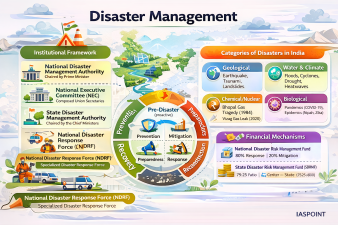
Disaster management in India shifted from a relief-centric approach to a proactive prevention-cum-mitigation model following the enactment of the Disaster Management Act, 2005. This legislation established a multi-tier institutional structure:
- National Disaster Management Authority (NDMA): Chaired by the Prime Minister, it is the apex body for laying down policies and guidelines.
- National Executive Committee (NEC): Comprising Union Secretaries, it assists the NDMA and ensures the implementation of the National Plan.
- State Disaster Management Authority (SDMA): Chaired by the respective Chief Ministers.
- District Disaster Management Authority (DDMA): Chaired by the District Collector/Magistrate/Deputy Commissioner, acting as the planning and implementing body at the local level.
- National Disaster Response Force (NDRF): A specialized force for responding to threatening disaster situations or disasters.
The Disaster Management Cycle
To cover the subject 360°, the management cycle is divided into Pre-Disaster and Post-Disaster phases.
Pre-Disaster Phase (Proactive)
- Prevention: Actions to avoid the adverse impacts of hazards (e.g., land-use planning).
- Mitigation: Structural and non-structural measures to limit the adverse impacts (e.g., building flood embankments or retrofitting buildings).
- Preparedness: Developing early warning systems, stockpiling supplies, and conducting mock drills.
Post-Disaster Phase (Reactive)
- Response: Immediate actions to save lives and meet basic subsistence needs.
- Recovery: Short-term restoration of essential services.
- Reconstruction: Long-term rebuilding of infrastructure based on the “Build Back Better” principle.
Categorization of Disasters in India
| Category | Key Examples |
| Geological | Earthquakes, Tsunami, Landslides, Avalanches |
| Water & Climate | Floods, Cyclones, Drought, Cloudbursts, Heatwaves |
| Chemical/Nuclear | Bhopal Gas Tragedy (1984), Vizag Gas Leak (2020) |
| Biological | Pandemics (COVID-19), Epidemics (Nipah, Zika) |
Major Natural Hazards: Facts and Statistics
Earthquakes
- Vulnerability: Approximately 59% of India’s landmass is prone to earthquakes of moderate to very high intensity.
- Zoning: India is divided into four seismic zones (II, III, IV, and V). Zone V is the most active, covering the Himalayas, North-East India, and the Rann of Kutch.
- Measurement: Magnitude is measured on the Richter Scale, while intensity (damage) is measured on the Mercalli Scale.
Cyclones
- Exposure: India has a coastline of 7,516 km, with nearly 10% of the world’s tropical cyclones occurring in the North Indian Ocean.
- Comparison: The Bay of Bengal witnesses a higher frequency of cyclones compared to the Arabian Sea (ratio of 4:1) due to higher sea surface temperatures and the influx of low-pressure systems from the South China Sea.
- Color-Coded Alerts: IMD uses Yellow (Be Updated), Orange (Be Prepared), and Red (Take Action) alerts.
Floods and Droughts
- Flood Vulnerability: Over 40 million hectares (12% of total land) are prone to floods. The Rashtriya Barh Ayog is the nodal agency for flood assessment.
- Urban Flooding: A distinct phenomenon caused by unplanned urbanization and the “Urban Heat Island” effect (e.g., Chennai 2015, Bengaluru 2022).
- Drought Management: Unlike other disasters, droughts have a “slow onset.” The Ministry of Agriculture is the nodal ministry for monitoring.
International Frameworks and Agreements
India is a signatory to major global frameworks that guide domestic policy:
- Yokohama Strategy (1994): Emphasized disaster prevention and preparedness.
- Hyogo Framework for Action (2005-2015): Focused on building the resilience of nations and communities.
- Sendai Framework (2015-2030): The current global roadmap. It lists four priorities: understanding risk, strengthening governance, investing in resilience, and enhancing preparedness for “Build Back Better.”
- Prime Minister’s 10-Point Agenda: Launched at the Asian Ministerial Conference on Disaster Risk Reduction (AMCDRR) 2016, it emphasizes local community involvement and women’s leadership in disaster risk management.
Financial Mechanisms for Disaster Management
Under the 15th Finance Commission recommendations, the funding structure was revamped:
- National Disaster Risk Management Fund (NDRMF): Replaced the NDRF, with allocations now split between Response (80%) and Mitigation (20%).
- State Disaster Risk Management Fund (SDRMF): Funded by the Center and States in a 75:25 ratio (90:10 for Himalayan and North-Eastern states).
- Capacity Building: Dedicated funds for training local bodies and the NDRF.
Disaster Management Trivia and Key Terms
- First State to enact DM Act: Gujarat (2001) following the Bhuj Earthquake.
- Nodal Ministries: * Earthquake/Tsunami: Ministry of Home Affairs.
- Drought: Ministry of Agriculture.
- Flood: Ministry of Jal Shakti.
- Nuclear Accidents: Department of Atomic Energy.
- Standard Operating Procedure (SOP): A set of step-by-step instructions compiled by an organization to help workers carry out complex routine operations.
- Glacial Lake Outburst Flood (GLOF): A type of flood occurring when the dam containing a glacial lake fails (e.g., South Lhonak Lake, Sikkim 2023).