

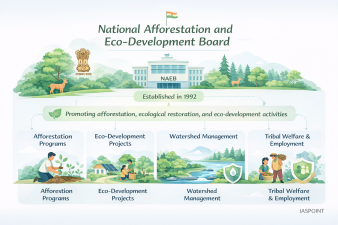
The National Afforestation and Eco-Development Board (NAEB) was established in August 1992 under the Ministry of Environment, Forest and Climate Change (MoEFCC). It was created to promote afforestation, tree planting, ecological restoration, and eco-development activities in the country, specifically focusing on degraded forest areas and adjoining lands.
- Predecessor: It took over functions related to afforestation from the National Wastelands Development Board (NWDB), which was then shifted to the Ministry of Rural Development to focus on non-forest wastelands.
- Mandate: The NAEB serves as the nodal agency for coordinating and monitoring the implementation of afforestation programs across India.
Core Objectives and Functions
The NAEB is tasked with a multidimensional role that bridges ecological restoration with rural livelihood security.
- Ecological Restoration: Rehabilitating degraded forest areas and ecologically fragile zones, such as the Himalayas, Western Ghats, and coastal areas.
- Wasteland Reclamation: Restoring and greening degraded lands, including community lands and private lands, through social forestry and agro-forestry.
- Public Participation: Evolving mechanisms for the involvement of the public, particularly local communities and Non-Governmental Organizations (NGOs), in afforestation efforts.
- Technical Assistance: Providing technical expertise and financial assistance for the development of fuel-wood, fodder, and timber species.
- Database Management: Creating a database on the status of forest degradation and the progress of afforestation schemes.
Major Schemes Managed by NAEB
The NAEB operates primarily through umbrella schemes designed to integrate central funding with state-level execution.
National Afforestation Programme (NAP)
This is the flagship scheme of the NAEB, implemented through a three-tier institutional setup:
- State Forest Development Agency (SFDA): At the state level.
- Forest Development Agency (FDA): At the Forest Division level.
- Joint Forest Management Committees (JFMCs): At the village level. The scheme provides 100% central funding for the regeneration of degraded forests and adjoining areas.
Eco-Development Forces (EDF) Scheme
This unique scheme involves the establishment of Eco-Task Force (ETF) Battalions, which consist of ex-servicemen.
- Objective: To undertake afforestation and restoration in highly difficult or sensitive terrains where local recruitment or traditional forest department methods might face challenges.
- Execution: The Ministry of Defence provides the personnel, while the NAEB provides the funding for project costs and equipment.
Institutional Structure: The Three-Tier NAEB Setup
| Level | Body Responsible | Role |
| State | State Forest Development Agency (SFDA) | Policy guidance and fund channelization. |
| Division | Forest Development Agency (FDA) | Planning and technical supervision. |
| Village | Joint Forest Management Committee (JFMC) | Implementation, protection, and benefit sharing. |
Specific Focus Areas for UPSC Prelims
- Eco-Development: Unlike simple afforestation, “Eco-development” includes activities that provide alternative livelihoods to forest-dependent communities to reduce their pressure on forest resources.
- The Green India Mission (GIM) Linkage: While GIM is one of the eight missions under the National Action Plan on Climate Change (NAPCC), NAEB’s National Afforestation Programme (NAP) is a key component that helps achieve GIM targets.
- Nodal Ministry: It is important to remember that NAEB is under the Ministry of Environment, Forest and Climate Change, whereas the National Wasteland Development Board (NWDB) is under the Ministry of Rural Development.
Key Initiatives and Recent Trends
Multi-Species Planting
The NAEB has shifted its strategy from monoculture (planting a single species like Eucalyptus) to multi-species plantations. This ensures biodiversity conservation and provides a variety of minor forest produce for local inhabitants.
Use of Technology
- Bhuvan Portal: NAEB utilizes the Bhuvan Geo-platform (developed by ISRO) for monitoring and evaluation of plantation sites under the NAP.
- Management Information System (MIS): Real-time tracking of funds and physical progress of afforestation projects to ensure transparency and accountability.
Trivia and Quick Facts
- Eco-Task Force Areas: Significant work has been done by ETF Battalions in the Shivalik hills of Haryana, the Pithoragarh region of Uttarakhand, and the Thar Desert in Rajasthan.
- Seed Banks: NAEB supports the creation of local seed banks to ensure that indigenous and site-specific species are used in afforestation rather than exotic varieties.
- Carbon Sequestration: The board’s activities are integral to India’s Intended Nationally Determined Contributions (INDCs) under the Paris Agreement, which aims to create an additional carbon sink of 2.5 to 3 billion tonnes of CO2 equivalent through additional forest and tree cover by 2030.