
The debate between environmental conservation and economic development is a central theme in global and national policy. It explores the tension between the need for economic growth to alleviate poverty and the necessity of preserving natural ecosystems to ensure long-term planetary survival.
Philosophical and Economic Paradigms
The conflict is often viewed through two competing lenses that shape how nations approach resource management.
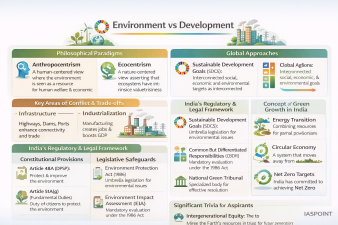
- Anthropocentrism: A human-centered view where the environment is seen as a resource to be exploited for human welfare and economic progress.
- Ecocentrism: A nature-centered view asserting that ecosystems have intrinsic value regardless of their utility to humans.
- The Decoupling Theory: The economic goal of “decoupling” growth from environmental pressure, where GDP grows while resource use and carbon emissions decrease.
Key Areas of Conflict and Trade-offs
| Area | Development Drivers | Environmental Impact |
| Infrastructure | Highways, dams, and ports enhance connectivity and trade. | Deforestation, habitat fragmentation, and loss of biodiversity. |
| Industrialization | Manufacturing creates jobs and boosts GDP through exports. | Air and water pollution, toxic waste, and GHG emissions. |
| Urbanization | Cities are engines of growth, housing, and modern services. | Urban heat islands, depletion of groundwater, and waste management crises. |
| Agriculture | Intensive farming ensures food security for a growing population. | Soil degradation, pesticide runoff, and loss of indigenous crop varieties. |
India’s Regulatory and Legal Framework
India attempts to balance these competing interests through a series of constitutional provisions and legislative acts.
Constitutional Provisions
- Article 48A (DPSP): The State shall endeavor to protect and improve the environment and safeguard forests and wildlife.
- Article 51A(g) (Fundamental Duties): It is the duty of every citizen to protect and improve the natural environment.
Legislative Safeguards
- Environment Protection Act (1986): An “umbrella” legislation providing a framework for coordination between central and state authorities.
- Environmental Impact Assessment (EIA): A mandatory process under the 1986 Act for evaluating the likely environmental impacts of a proposed project, ensuring “informed decision-making.”
- National Green Tribunal (NGT): A specialized judicial body established in 2010 for the effective and expeditious disposal of cases relating to environmental protection.
Global Approaches to Resolution
Several international frameworks aim to harmonize the two ends of the spectrum.
- Sustainable Development Goals (SDGs): These goals treat social, economic, and environmental targets as interconnected rather than mutually exclusive.
- Common But Differentiated Responsibilities (CBDR): A principle within the UNFCCC acknowledging that while all nations must protect the environment, developed nations bear a greater historical responsibility and should provide financial/technical aid to developing ones.
- Circular Economy: A model that moves away from “take-make-dispose” to a system where products are designed for reuse, repair, and recycling, minimizing environmental footprint.
Concept of Green Growth in India
India has adopted a strategy of “Green Growth” to bridge the gap between development and ecology.
- Energy Transition: Significant shift toward renewables (Solar, Wind, Green Hydrogen) to meet energy demands without proportional increases in emissions.
- Lifestyle for Environment (LiFE): A global movement launched by India at COP26 to encourage individual and collective action toward mindful and deliberate utilization of resources.
- Ecosystem Services Valuation: An emerging approach that assigns economic value to the “services” provided by nature (e.g., carbon sequestration by forests, water purification by wetlands) to justify their conservation over industrial use.
Significant Trivia for Aspirants
- Intergenerational Equity: The principle that the current generation holds the Earth’s resources in trust for future generations.
- Precautionary Principle: A legal concept where, if an action has a suspected risk of causing harm to the public or the environment, the burden of proof that it is not harmful falls on those taking the action.
- Polluter Pays Principle: The practice that those who produce pollution should bear the costs of managing it to prevent damage to human health or the environment.
- Net Zero Targets: India has committed to achieving Net Zero emissions by 2070, reflecting a long-term commitment to balance development with climate stability.