

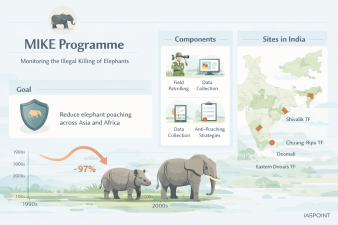
The Monitoring the Illegal Killing of Elephants (MIKE) programme is an international site-based monitoring system established by a resolution of the Conference of the Parties (CoP) to CITES (Convention on International Trade in Endangered Species of Wild Fauna and Flora). It was initiated in 2001 to track trends in the illegal killing of elephants and to provide a basis for international cooperation in their conservation.
Core Objectives
MIKE was designed to provide information for elephant range states to make appropriate management and enforcement decisions.
- Measuring Levels and Trends: To measure levels and trends in the illegal killing of elephants.
- Determining Causes: To determine whether these trends are related to changes in the listing of elephant populations in the CITES appendices or decisions of the CoP.
- Capacity Building: To build capacity in range states for the long-term monitoring of elephant populations.
Operational Mechanism: The PIKE Index
The primary indicator used by the MIKE programme is the PIKE (Proportion of Illegally Killed Elephants) index.
- Calculation: PIKE is calculated as the number of illegally killed elephants found, divided by the total number of elephant carcasses encountered by patrol teams or other means.
- Significance: A PIKE value above 0.5 is generally considered a cause for concern, indicating that more than half of the elephant deaths in that area are due to poaching.
MIKE in India
India is a significant participant in the MIKE programme, given its status as the home to the largest population of Asian Elephants (Elephas maximus).
| Feature | Details |
| Nodal Agency | Project Elephant Division, Ministry of Environment, Forest and Climate Change (MoEFCC). |
| Number of Sites | 10 designated MIKE sites across India. |
| Focus Species | Asian Elephant (listed in CITES Appendix I). |
List of MIKE Sites in India
These sites represent different elephant landscapes across the country and are crucial for UPSC Prelims mapping questions.
- Northeast India:
- Chirang-Ripu (Assam)
- Dihing Patkai (Assam)
- Garo Hills (Meghalaya)
- Deomali (Arunachal Pradesh)
- East India:
- Mayurbhanj (Odisha)
- North India:
- Shivalik (Uttarakhand)
- South India:
- Mysore (Karnataka)
- Nilgiri (Tamil Nadu)
- Wayanad (Kerala)
- Agasthyamalai (Tamil Nadu/Kerala)
Global Context and CITES Appendices
The MIKE programme monitors both African and Asian elephants. The legal status under CITES varies by population.
- Appendix I: Includes all Asian elephants and most African elephant populations (International trade in ivory is prohibited).
- Appendix II: Includes African elephant populations of Botswana, Namibia, South Africa, and Zimbabwe (subject to specific trade controls).
Threats Monitored under MIKE
- Poaching for Ivory: The primary driver for illegal killing, despite the global ban on ivory trade.
- Human-Elephant Conflict (HEC): Retaliatory killings due to crop raiding or human casualties.
- Habitat Fragmentation: Monitoring how land-use changes correlate with illegal killing incidents.
Related International Initiatives
- ETIS (Elephant Trade Information System): A sister program to MIKE, ETIS manages a database of seizures of elephant ivory and other elephant products to monitor the illegal trade route.
- African Elephant Fund: A multi-donor technical fund to support the implementation of the African Elephant Action Plan.
- World Elephant Day: Observed on August 12 to highlight the plight of Asian and African elephants.
Trivia for UPSC Prelims
- Elephant Conservation Status: Endangered (IUCN Red List); Schedule I (Wildlife Protection Act, 1972).
- Elephant Census: Conducted once every five years in India. The 2017 census estimated the population at approximately 27,312.
- National Heritage Animal: The Elephant was declared the National Heritage Animal of India in 2010.
- Gaj Utsav: A festival organized at Kaziranga National Park to celebrate 30 years of Project Elephant and promote conservation.