
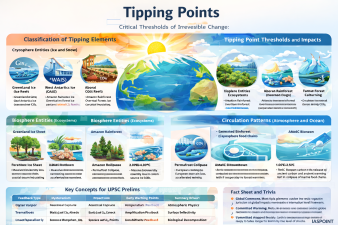
In the context of Earth System Sciences, a Tipping Point is a critical threshold beyond which a tiny additional perturbation can cause a large, non-linear, and often irreversible change in the state of the system. Unlike gradual climate change, reaching a tipping point triggers “runaway” processes that continue even if the original forcing (like greenhouse gas emissions) is stopped.
Classification of Tipping Elements
Tipping elements are large-scale components of the Earth system that may pass a tipping point. These are generally categorized by their physical and biological characteristics.
Cryosphere Entities (Ice and Snow)
- Greenland Ice Sheet (GIS): Melting is accelerated by the elevation-prediction feedback. As the ice sheet melts, its surface sinks into warmer, lower-altitude air, further accelerating melting. Complete loss could raise global sea levels by approximately 7 meters.
- West Antarctic Ice Sheet (WAIS): Primarily vulnerable due to Marine Ice Sheet Instability. Much of the ice rests on bedrock below sea level; as warm ocean water erodes the base, the retreat becomes self-sustaining.
- Arctic Permafrost: Large-scale thawing releases methane and carbon dioxide, creating a self-reinforcing warming loop.
Biosphere Entities (Ecosystems)
- Amazon Rainforest: Vulnerable to “dieback.” The forest creates its own rainfall through transpiration. If deforestation and warming cross a threshold (estimated at 20-25% forest loss), the region could shift from a moist rainforest to a dry savannah, releasing billions of tons of carbon.
- Boreal Forests: Increased heat stress and pest outbreaks (like bark beetles) lead to large-scale forest dieoff in northern latitudes, shifting the carbon balance of the sub-arctic.
- Coral Reefs: A 2°C increase in global temperatures is projected to lead to the loss of >99% of tropical coral reefs due to bleaching and ocean acidification.
Circulation Patterns (Atmosphere and Ocean)
- Atlantic Meridional Overturning Circulation (AMOC): A system of currents (including the Gulf Stream) that transports warm water north. Increased freshwater from melting Greenland ice dilutes salinity, potentially “shutting down” the conveyor belt. This would drastically cool the North Atlantic and disrupt global monsoon patterns.
- Indian Monsoon: Shifts in atmospheric aerosol loading and ocean warming could lead to a tipping point where the monsoon becomes highly erratic or shifts its path, impacting food security for billions.
Tipping Point Thresholds and Impacts
The following table outlines the estimated temperature thresholds for key tipping elements as identified by the Intergovernmental Panel on Climate Change (IPCC) and recent scientific literature.
| Tipping Element | Estimated Threshold | Potential Impact |
| Greenland Ice Sheet | 1.5°C – 3.0°C | Substantial global sea-level rise |
| West Antarctic Ice Sheet | 1.5°C – 3.0°C | Rapid sea-level rise; coastal inundation |
| Amazon Rainforest | 2.0°C – 4.0°C | Massive biodiversity loss; carbon source shift |
| AMOC Shutdown | 3.0°C – 5.0°C | European cooling; shift in tropical rain belts |
| Permafrost Collapse | 1.5°C – 2.5°C | Release of “ancient” carbon; accelerated warming |
| Coral Reef Bleaching | 1.0°C – 1.5°C | Collapse of marine food chains |
Key Concepts for UPSC Prelims
Hysteresis and Irreversibility
Hysteresis refers to the “path dependency” of a system. Once a tipping point is crossed, returning to the original temperature does not immediately restore the system. For example, if the Greenland ice sheet melts, it would not regrow simply by lowering CO2 to pre-industrial levels because the high-altitude “cold trap” it once occupied no longer exists.
Cascading Tipping Points
Tipping points do not exist in isolation. The “domino effect” occurs when crossing one threshold triggers another.
- Example: Arctic sea ice loss (1) increases Arctic warming through albedo feedback, which accelerates Greenland ice melt (2). This freshwater influx slows the AMOC (3), which in turn shifts the Intertropical Convergence Zone (ITCZ), potentially drying out the Amazon (4).
Early Warning Signals (EWS)
Scientists look for “Critical Slowing Down” as a system nears a tipping point. This is characterized by the system taking longer to recover from small shocks (like a particularly hot summer), indicating that its internal stabilizing mechanisms are weakening.
Fact Sheet and Trivia
- Global Commons: Most tipping elements are located in areas outside national jurisdiction or have global impacts, making them “Global Commons” that require international legal frameworks.
- Committed Warming: Even if all emissions stopped today, the Earth is “committed” to some level of warming that may already have pushed the West Antarctic Ice Sheet past its point of no return.
- The 1.5°C Limit: The primary scientific rationale for the Paris Agreement’s 1.5°C goal is to minimize the probability of triggering these large-scale, irreversible tipping points.
- Boreal Shift: While the Amazon risks turning into savannah, some parts of the Arctic tundra are tipping toward becoming shrubland/forest, a process known as “shrubification.”