

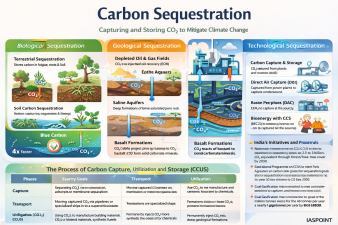
Carbon sequestration is the process of capturing and storing atmospheric carbon dioxide (CO2) to mitigate global warming and avoid dangerous climate change. It represents a critical pillar of “Net Zero” strategies, acting as a “negative emission” technology to balance residual emissions from hard-to-abate sectors.
Types of Carbon Sequestration
Carbon sequestration is broadly classified based on the mechanism of storage and the medium used.
Biological (Natural) Sequestration
This involves using natural ecosystems to act as carbon “sinks.”
- Terrestrial Sequestration: Carbon is stored in the stems, branches, foliage, and roots of plants and within the soil.
- Soil Carbon Sequestration: Through conservation tillage and cover cropping, carbon is fixed into the soil as organic matter. This is a key component of Regenerative Agriculture.
- Blue Carbon: This refers to carbon sequestered by coastal and marine ecosystems, specifically Mangroves, Seagrasses, and Salt Marshes. These are highly efficient; for instance, mangroves can store up to 4 times more carbon per hectare than tropical rainforests.
Geological Sequestration
This involves the capture of CO2 from industrial sources and its long-term storage in underground formations.
- Depleted Oil and Gas Reservoirs: CO2 is injected into old reservoirs, sometimes used for Enhanced Oil Recovery (EOR).
- Saline Aquifers: Deep formations of porous rock saturated with brine (salt water) offer the largest potential storage capacity globally.
- Basalt Formations: CO2 injected into basaltic rock reacts with minerals to turn into solid carbonate minerals (e.g., the Carbfix project in Iceland).
Technological (Industrial) Sequestration
Direct intervention using engineering solutions to remove CO2 from the air or flue gases.
- Carbon Capture and Storage (CCS): Capturing CO2 at the point of emission (power plants or factories) and transporting it to a storage site.
- Direct Air Capture (DAC): Using chemical reactions to pull CO2 directly from the ambient air. It is more expensive than CCS due to the low concentration of CO2 in the atmosphere compared to flue gas.
- Bioenergy with Carbon Capture and Storage (BECCS): Burning biomass for energy and capturing the resulting CO2. This is considered “carbon negative” because plants remove CO2 while growing.
The Process of Carbon Capture, Utilization, and Storage (CCUS)
The CCUS framework extends beyond simple storage to include the productive use of captured carbon.
| Phase | Description |
| Capture | Separating CO2 from other gases using absorption (chemical solvents), adsorption, or membrane separation. |
| Transport | Moving captured CO2 via pipelines or specialized ships in a “supercritical” (liquid-like) state. |
| Utilization (CCU) | Using CO2 to manufacture building materials (carbon-cured concrete), synthetic fuels, or chemicals. |
| Storage (CCS) | Permanent injection into deep geological formations. |
India’s Initiatives and Potential
India’s Long-Term Low-Emission Development Strategy (LT-LEDS) emphasizes CCUS as a vital technology for reaching Net Zero by 2070.
- National Programme on CCUS: Under the Department of Science and Technology (DST), India has established two National Centres of Excellence in CCUS at IIT Bombay and Jawaharlal Nehru Centre for Advanced Scientific Research (JNCASR).
- Forestry Goals: Under its Intended Nationally Determined Contributions (INDCs), India aims to create an additional carbon sink of 2.5 to 3 billion tonnes of CO2 equivalent through additional forest and tree cover by 2030.
- Coal Gasification: The government is promoting coal gasification which makes CO2 capture more concentrated and efficient compared to traditional combustion.
Challenges and Limitations
- Cost: DAC and CCS technologies remain prohibitively expensive (ranging from $600 to $1,000 per ton of CO2 for DAC).
- Energy Intensity: The capture process itself requires significant energy, potentially leading to “energy penalties.”
- Permanence and Leakage: Risks involve the potential for CO2 to leak from geological reservoirs back into the atmosphere or into groundwater.
- Scale: To meet Paris Agreement goals, sequestration must scale up from the current 45 million tonnes per year to nearly 1 gigatonne per year by 2030.
UPSC Trivia: The “Ocean Fertilization” Concept
Ocean fertilization is a theoretical form of geoengineering where iron or other nutrients are added to the ocean’s “biological pump” to stimulate phytoplankton blooms. The idea is that these blooms will absorb CO2 and then sink to the deep ocean floor when they die. However, it remains controversial due to potential unknown impacts on marine food webs and oxygen depletion.
Last Modified: April 20, 2026