
India’s sustainability landscape is governed by a shift from voluntary corporate social responsibility to a structured, mission-mode approach.
The “Panchamrit” Framework (COP26 Commitments)
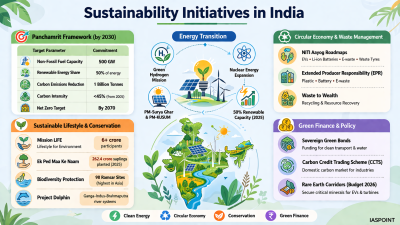
Announced at COP26 and updated in India’s Nationally Determined Contributions (NDCs), these five targets form the bedrock of India’s sustainability strategy.
| Target Parameter | Commitment for 2030 | Current Status (as of April 2026) |
| Non-Fossil Fuel Capacity | 500 GW | 283.46 GW reached by March 31, 2026. |
| Renewable Energy Share | 50% of energy requirements | Reached 50% of installed capacity in June 2025. |
| Carbon Emissions Reduction | 1 Billion Tonnes (Cumulative) | Ongoing; intensive decarbonization in Railways/Steel. |
| Carbon Intensity of Economy | <45% reduction from 2005 levels | On track; significant decoupling of GDP from emissions. |
| Net Zero Target | By 2070 | Long-term strategy submitted to UNFCCC. |
Major Energy Transition Initiatives
National Green Hydrogen Mission (NGHM)
Launched with an outlay of ₹19,744 crore, the mission aims to make India a global hub for the production and export of Green Hydrogen.
- Target: 5 Million Metric Tonnes (MMT) per annum by 2030.
- Current Progress: As of February 2026, India has commissioned 8,000 Tonnes Per Annum (TPA) capacity.
- Incentives: The SIGHT Program (Strategic Interventions for Green Hydrogen Transition) provides financial incentives for domestic electrolyzer manufacturing.
Solar Power and PM-Surya Ghar
India is currently the third-largest renewable energy capacity holder globally (after China and the US).
- PM-Surya Ghar: Muft Bijli Yojana: Aimed at providing free electricity to 1 crore households through rooftop solar. Rooftop solar capacity crossed 25.7 GW in March 2026.
- PM-KUSUM: De-dieselizing the farm sector by installing solar pumps and solarizing grid-connected agriculture pumps.
Nuclear Energy Expansion
The Union Budget 2026-27 launched a new Nuclear Energy Mission, specifically focusing on Small Modular Reactors (SMRs) to provide round-the-clock (RTC) clean power to industrial clusters.
Circular Economy and Waste Management
The government has shifted focus from “Waste Management” to “Waste to Wealth” through a circular economy framework.
NITI Aayog’s Circular Economy Reports (2026)
In early 2026, NITI Aayog released comprehensive roadmaps for four critical sectors:
- End-of-Life Vehicles (ELVs): Formalizing the vehicle scrapping industry to recover steel and aluminum.
- Lithium-ion Batteries: Ensuring critical mineral security (Lithium, Cobalt) through urban mining.
- E-waste: Managing the projected 14 MMT of e-waste expected by 2030.
- Waste Tyres: Utilizing crumb rubber in road construction and industrial applications.
Extended Producer Responsibility (EPR)
EPR mandates are now strictly enforced for:
- Plastic Waste: Phase-out of identified single-use plastics (SUPs).
- Battery Waste: Mandatory recycling targets for manufacturers.
- E-waste: Formalizing the informal recycling sector through digital traceability.
Sustainable Lifestyle and Conservation Missions
Mission LiFE (Lifestyle for Environment)
A global movement led by India to replace “mindless consumption” with “mindful utilization.”
- Participation: Over 6 crore people participated in LiFE events by late 2025.
- Focus: Conserving water, reducing waste, and adopting sustainable food systems.
Biodiversity and Afforestation
- Ek Ped Maa Ke Naam (Plant4Mother): A massive people-centric campaign that resulted in 262.4 crore saplings planted by the end of 2025.
- Ramsar Sites: India now hosts 98 Ramsar Sites (as of January 2026), the highest in Asia, reflecting a strong commitment to wetland conservation.
- Project Dolphin: A range-wide estimation launched in January 2026 covers major river systems including the Ganga, Indus, and Brahmaputra.
Green Finance and Economic Policy
Sovereign Green Bonds (SGrBs)
The Government of India continues to issue Green Bonds to fund projects in renewable energy, clean transportation, and water management. These bonds reduce the “green premium” for sustainable infrastructure.
Carbon Credit Trading Scheme (CCTS)
India is developing a domestic Carbon Market to allow industries to trade carbon credits, incentivizing decarbonization in “hard-to-abate” sectors like cement, steel, and chemicals.
Rare Earth Corridors
Announced in Budget 2026, these corridors (in states like Odisha, Andhra Pradesh, and Tamil Nadu) aim to secure the full value chain for permanent magnets used in EV motors and wind turbines, ensuring resource sovereignty for the green transition.
Last Modified: April 20, 2026