
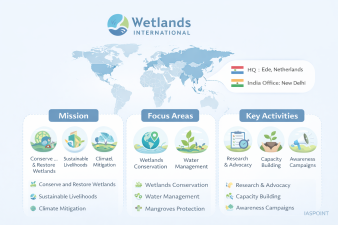
Wetlands International is the only global not-for-profit organization dedicated solely to the conservation and restoration of wetlands. It is an independent, non-governmental, and non-profit entity that works to maintain and restore wetlands and their resources for people and biodiversity. It is widely recognized as a “science-based” organization that bridges the gap between field-level implementation and international policy-making.
Origin and Evolutionary History
The organization has a legacy spanning over 80 years, evolving from a group focused on waterbirds to a global wetland conservation authority.
- 1937: Founded as the International Wildfowl Inquiry, focused on protecting waterbirds.
- 1954: Renamed as the International Waterfowl & Wetlands Research Bureau (IWRB), expanding its scope to include wetland habitats.
- 1996: Wetlands International was formally established in its current form through the merger of three regional organizations:
- IWRB (Europe, Africa, and the Middle East)
- Asian Wetland Bureau (AWB) (formerly INTERWADER, est. 1983)
- Wetlands for the Americas (WA) (est. 1989)
- Headquarters: Located in Wageningen, the Netherlands.
Core Objectives and Strategy
The organization’s strategy for 2026–2035, titled “Wetlands for Life,” focuses on driving systemic change at global and landscape levels.
- Global Advocacy: It is one of the six International Organization Partners (IOPs) of the Ramsar Convention on Wetlands.
- Science-Policy Interface: Provides technical and scientific advice to the Ramsar Secretariat and member nations to help meet Sustainable Development Goals (SDGs).
- Landscape Scale Restoration: Focuses on restoring entire deltas, river basins, and peatland landscapes rather than isolated sites.
- Community Resilience: Empowering local communities to manage wetlands sustainably for climate adaptation and food security.
Major Global Initiatives and Tools
Wetlands International is responsible for several critical databases and monitoring programs used by environmentalists worldwide.
- International Waterbird Census (IWC): A global monitoring program that collects data on waterbird populations in over 100 countries. It is the primary data source for designating Ramsar sites under waterbird criteria.
- Waterbird Population Estimates (WPE): An online database providing population size and trend information for all waterbird species globally.
- Global Mangrove Watch (GMW): An online platform that uses satellite imagery to monitor changes in mangrove cover, supporting the Mangrove Breakthrough initiative.
- Peatland Conservation: Actively works on the Global Peatlands Initiative to protect carbon-rich peat ecosystems from drainage and fires.
Wetlands International in India (WISA)
The South Asia office, Wetlands International South Asia (WISA), was established in 1996 in New Delhi and became a registered non-profit Society in 2005.
- Collaborative Role: WISA works closely with the Ministry of Environment, Forest and Climate Change (MoEFCC) on the “Wetlands of India” portal.
- Key Projects:
- Loktak Lake (Manipur): Long-term involvement in the ecological restoration of the lake and its phumdis.
- Chilika Lake (Odisha): Provided scientific support for the restoration of its hydrological regime.
- Asian Waterbird Census (AWC): Coordinates the annual waterbird count across various Indian states.
- Frameworks: Developed the Management Effectiveness Tracking Tool (METT) specifically tailored for Indian wetlands to evaluate conservation outcomes.
Organizational Comparison: IOPs of the Ramsar Convention
Wetlands International is part of a select group of NGOs that have a formal partnership with the Ramsar Convention.
| Organization | Key Focus Area |
| Wetlands International | Scientific monitoring, restoration, and waterbird data. |
| IUCN | Global biodiversity standards and Red List status. |
| WWF International | Global advocacy, field projects, and freshwater conservation. |
| BirdLife International | Identification of Important Bird Areas (IBAs). |
| IWMI | Water resource management and agriculture-wetland links. |
| Wildfowl & Wetlands Trust (WWT) | Wetland education and habitat creation. |
Facts for UPSC Revision
- Legal Status: It is an NGO, not an intergovernmental body (unlike the UN) or a part of the Ramsar Convention Secretariat itself.
- Funding: Primarily project-based, funded by government memberships, private donors, and partner organizations.
- India Connection: India is a prominent partner, and the organization’s data is frequently cited in the India State of Forest Report (ISFR) and MoEFCC documents.
- Trivia: The organization was a pioneer in demonstrating the link between wetland degradation and the spread of zoonotic diseases (like Avian Flu).