
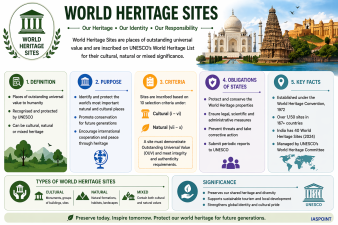
World Heritage Sites (WHS) are landmarks or areas with Outstanding Universal Value (OUV), officially recognized by UNESCO under the 1972 Convention Concerning the Protection of the World Cultural and Natural Heritage. These sites represent the peak of human creative genius or the most significant natural habitats on Earth.
- Global Governing Body: The World Heritage Committee, comprising representatives from 21 State Parties.
- India’s Standing (2026): India currently hosts 44 World Heritage Sites, ranking 6th globally in terms of the number of sites.
- Categories: UNESCO classifies sites into three types:
- Cultural: 35 sites (e.g., Taj Mahal, Dholavira).
- Natural: 8 sites (e.g., Kaziranga, Western Ghats).
- Mixed: 1 site (Khangchendzonga National Park).
Criteria for Selection
To be included, a site must meet at least one of the ten selection criteria.
- Cultural Criteria (i–vi): Includes masterpieces of human creative genius, exceptional testimony to a civilization, or an outstanding example of a type of building/architectural ensemble.
- Natural Criteria (vii–x): Includes areas of exceptional natural beauty, significant stages of earth’s history, or important natural habitats for biodiversity.
Recent Inscriptions (2024–2025)
India has seen significant additions recently, reflecting a focus on diverse regional history and military architecture.
Moidams – Mound-Burial System of the Ahom Dynasty (Assam, 2024)
- Context: Inscribed during the 46th session of the World Heritage Committee held in New Delhi.
- Significance: It is the first cultural site from Northeast India to be inscribed.
- Details: These are tumuli (burial mounds) used by the Tai-Ahom dynasty. The Charaideo site contains the royal burials, featuring vaulted chambers under hemispherical earthen mounds, reflecting the ancestral worship traditions of the Ahoms.
Maratha Military Landscapes (Maharashtra & Tamil Nadu, 2025)
- Context: Added as the 44th site during the 47th session (2025).
- Significance: Showcases the military strategy of the Maratha Empire under Chhatrapati Shivaji Maharaj and subsequent rulers.
- Composition: A serial nomination of 12 components, including:
- Hill Forts: Raigad, Shivneri, Lohagad, Pratapgad.
- Coastal/Island Forts: Vijaydurg, Suvarnadurg, Sindhudurg.
- Inland Forts: Gingee Fort (Tamil Nadu).
- Technicality: It illustrates the integration of the Sahyadri mountain terrain and the Konkan coast into a formidable defensive network.
Summary of India’s World Heritage Sites
| Category | Count | Key Examples |
| Cultural | 35 | Taj Mahal, Hampi, Dholavira, Santiniketan, Hoysala Temples, Moidams, Maratha Military Landscapes. |
| Natural | 8 | Kaziranga, Manas, Keoladeo, Sundarbans, Nanda Devi & Valley of Flowers, Western Ghats, Great Himalayan NP. |
| Mixed | 1 | Khangchendzonga National Park (Sikkim). |
The Mixed Site: Khangchendzonga National Park
Khangchendzonga (Sikkim) is India’s only Mixed Heritage Site (2016), recognized for both natural and cultural values.
- Natural Value: Includes a unique range of plains, valleys, lakes, glaciers, and spectacular snow-capped mountains covered with ancient forests. It contains Mount Khangchendzonga, the third-highest peak in the world.
- Cultural Value: The mountain is sacred to the Sikkimese people. The “Beyul” (sacred hidden land) concept and Tibetan Buddhist beliefs are deeply integrated with the landscape.
Administrative and Preparatory Concepts
- Tentative List: For a site to be considered, it must first be on the “Tentative List” for at least one year. India currently has over 60 sites on this list (including Sarnath and the Living Root Bridges of Meghalaya).
- Nomination Dossier: A detailed document prepared by the Archaeological Survey of India (ASI) or relevant state agencies proving the site’s OUV.
- Advisory Bodies: * ICOMOS: International Council on Monuments and Sites (Evaluates Cultural sites).
- IUCN: International Union for Conservation of Nature (Evaluates Natural sites).
Quick Facts for UPSC Prelims
- First Sites in India (1983): Ajanta Caves, Ellora Caves, Agra Fort, and the Taj Mahal.
- States with most sites: Maharashtra leads with the highest number of UNESCO sites (including Ajanta, Ellora, Elephanta, CST, Victorian Gothic Ensembles, and the Maratha Landscapes).
- Serial Sites: Sites like the Western Ghats (39 sub-sites) and the Mountain Railways of India (Darjeeling, Nilgiri, Kalka-Shimla) are registered as a single entry despite being geographically spread.
- Transboundary Site: The “Architectural Work of Le Corbusier” (Chandigarh) is part of a global serial nomination spanning several countries.