

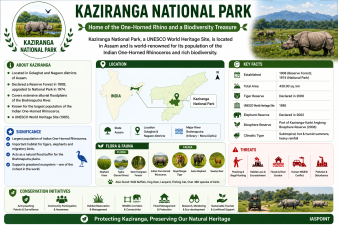
Kaziranga National Park (KNP), located in the Golaghat, Nagaon, and Biswanath districts of Assam, is India’s flagship site for the conservation of the One-horned Rhinoceros. It is a pinnacle of successful wildlife management and holds multiple prestigious designations.
- National Park Status: Established as a Reserve Forest in 1905, it was declared a National Park in 1974.
- UNESCO World Heritage Site: Inscribed in 1985 for its unique natural environment and evolutionary significance.
- Tiger Reserve: Notified as a Tiger Reserve in 2006, boasting one of the highest tiger densities in the world.
- Important Bird Area (IBA): Recognized by BirdLife International for the conservation of avifaunal species.
Geography and Riverine Dynamics
Kaziranga is situated in the Brahmaputra Valley floodplain, making its ecosystem highly dynamic and dependent on annual rejuvenation through flooding.
- Riverine Boundaries: The park is bounded by the Brahmaputra River to the north and the Mora Diphlu to the south. Other significant rivers include the Diphlu and Dhansiri.
- Topography: It is characterized by “Beels” (wetlands), “Chapories” (sandbars), and “Terai” grasslands.
- The Karbi Anglong Link: To the south of the park lie the Karbi Anglong Hills. This highland connectivity is crucial for animal survival during the monsoon floods.
The “Big Five” of Kaziranga
The park is world-renowned for hosting the “Big Five” mammals of India, maintaining some of the largest populations of these species globally.
| Species | Significance |
| Great Indian One-horned Rhino | Hosts ~2/3rd of the world’s population; listed as Vulnerable (IUCN). |
| Royal Bengal Tiger | Highest density among protected areas; core area of Kaziranga Tiger Reserve. |
| Asian Elephant | Significant population; part of the Kaziranga-Karbi Anglong Elephant Reserve. |
| Wild Water Buffalo | Holds the largest global population of this species (distinct from domestic buffalo). |
| Swamp Deer (Barasingha) | Specifically the Eastern Swamp Deer subspecies; highly dependent on the park’s tall grasslands. |
Flora and Habitat Types
The vegetation of Kaziranga is classified into four broad types, maintaining a mosaic that supports high herbivore density.
- Alluvial Savanna Grasslands: Dominant habitat featuring “Elephant Grass” (Saccharum ravennae).
- Tropical Moist Mixed Deciduous Forests: Found in higher elevations.
- Tropical Semi-evergreen Forests: Along the edges of water bodies.
- Marshland Vegetation: Floating and emergent aquatic plants in the numerous “Beels.”
Conservation Challenges and Innovations
- Annual Floods: While floods are essential for nutrient replenishment, extreme flooding leads to high animal mortality and forces migration toward Karbi Anglong.
- Poaching: Historically a major threat to Rhinos for their horns. Implementation of “Commando” style protection and the use of drones have significantly reduced incidents.
- National Highway-37: The highway cuts through the southern boundary. To mitigate roadkills, the government has constructed several animal sensor-based underpasses.
- Invasive Species: The spread of Mimosa and Parthenium weeds poses a threat to the native grassland ecosystem.
Key Trivia for UPSC Prelims
- The 100-Year Success: In 1905, only about 12 rhinos were left; today the population exceeds 2,600.
- Lady Curzon’s Role: The park was created following the initiative of Mary Curzon, wife of Lord Curzon, after she failed to see a single rhino during her visit.
- The “Agoratoli” and “Bagori” Ranges: These are the prominent administrative ranges famous for eastern and western sightings, respectively.
- Carbon Sink: Recent studies indicate that Kaziranga is transitioning from a carbon sink to a carbon source due to the decreasing ability of its forests to absorb CO₂ amid changing rainfall patterns.
- Orchid Park: The Kaziranga National Orchid and Biodiversity Park nearby houses over 500 species of wild orchids.
Transboundary Connectivity
Kaziranga is the core of the Kaziranga-Karbi Anglong-Intanki landscape.
- Migration Corridors: There are nine identified animal corridors (e.g., Panbari, Haldibari, Amguri) that allow animals to reach the safety of the Karbi Anglong hills during floods. Protecting these corridors is currently the highest conservation priority for the Assam Forest Department.