

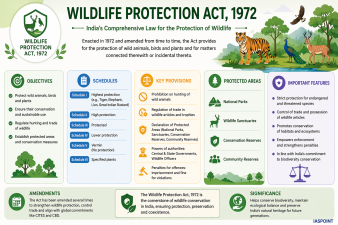
The Wildlife (Protection) Act (WPA), 1972 serves as the primary legal framework for the protection of wild animals, birds, and plants in India. Enacted under Article 252 of the Constitution, it was designed to ensure the ecological and environmental security of the country. Before 1972, India had only five designated national parks; today, the network has expanded significantly under this legislative umbrella.
Constitutional Provisions and Evolution
The WPA 1972 aligns with specific Constitutional mandates that emphasize the state’s duty toward nature.
- Article 48A: A Directive Principle of State Policy (DPSP) requiring the State to protect and improve the environment and safeguard wildlife.
- Article 51A(g): A Fundamental Duty of citizens to protect and improve the natural environment, including forests, lakes, rivers, and wildlife.
- Legislative Shift: Originally a State subject, “Protection of Wild Animals and Birds” was moved to the Concurrent List via the 42nd Amendment Act, 1976, allowing both Parliament and State Legislatures to legislate on the matter.
Statutory Bodies Established under WPA
The Act provides for the creation of several apex bodies to manage and oversee wildlife conservation:
- National Board for Wildlife (NBWL): Chaired by the Prime Minister, it serves as an advisory body for framing policies and measures for conservation. No alteration of boundaries in National Parks or Sanctuaries can be made without NBWL approval.
- State Board for Wildlife (SBWL): Chaired by the Chief Minister of the respective state.
- Central Zoo Authority (CZA): Established in 1992 to oversee the functioning of zoos and regulate the exchange of animals.
- National Tiger Conservation Authority (NTCA): A statutory body under the Ministry of Environment, Forest and Climate Change (MoEFCC) tasked with strengthening tiger conservation and implementing Project Tiger.
- Wildlife Crime Control Bureau (WCCB): Formed to combat organized wildlife crime in the country through intelligence gathering and coordination with international agencies.
Categorization of Protected Areas
The Act empowers Central and State governments to declare specific areas as “Protected Areas” for the purpose of protecting, propagating, or developing wildlife.
| Area Category | Description and Legal Status |
| National Parks | High degree of protection; no human activity is permitted inside except those allowed by the Chief Wildlife Warden. |
| Wildlife Sanctuaries | Certain rights of people (like grazing or fuel wood collection) may be permitted. |
| Conservation Reserves | Owned by the government, typically acting as buffer zones or connectors between established parks and sanctuaries. |
| Community Reserves | Declared on private or community land where individuals or communities have volunteered to conserve wildlife. |
Classification of Wildlife: The Schedule System
The 2022 Amendment significantly streamlined the original six schedules into four to align with CITES (Convention on International Trade in Endangered Species of Wild Fauna and Flora).
- Schedule I: Confers the highest level of protection. Species under this schedule (e.g., Tiger, Lion-tailed Macaque, Great Indian Bustard) are prohibited from being hunted throughout India, except under threat to human life or specific diseases.
- Schedule II: Contains species with a high level of protection but lower than Schedule I.
- Schedule III: Subject to the provisions of CITES (protected plant species).
- Schedule IV: Specifically dedicated to specimens listed in the Appendices of CITES (International Trade regulation).
Note on Vermin
Previously, Schedule V listed “Vermin” (animals that could be hunted, like common crows or fruit bats). The Central Government can still notify any wild animal (other than Schedule I species) as vermin for a specific period and area if they pose a threat to crops or human life.
Key Prohibitions and Authorities
Hunting and Poaching
Section 9 of the Act prohibits the hunting of any wild animal specified in Schedules I and II. “Hunting” includes capturing, killing, poisoning, or even disturbing the eggs or nests of birds and reptiles.
Chief Wildlife Warden (CWLW)
The CWLW is the statutory authority in a state who manages protected areas. Only the CWLW has the power to grant permits for hunting a Schedule I animal if it becomes “dangerous to human life” or is so disabled/diseased as to be beyond recovery.
Declaration of Sanctuaries
The State Government may, by notification, declare its intention to constitute an area as a sanctuary if it considers it to be of adequate ecological, faunal, floral, or geomorphological significance.
Wildlife Protection (Amendment) Act, 2022
The recent amendment brought transformative changes to ensure India meets its international obligations under CITES.
- CITES Implementation: It designates a Management Authority to grant export/import permits and a Scientific Authority to advise on the impact of trade on the survival of specimens.
- Invasive Alien Species: Empowers the Central Government to regulate or prohibit the import, trade, or possession of invasive alien species that may pose a threat to native wildlife.
- Voluntary Surrender: Allows individuals to voluntarily surrender any captive animals or animal products to the Chief Wildlife Warden without compensation.
- Religious Use of Elephants: A significant addition allows for the transfer or transport of live elephants for religious or any other purposes by a person having a valid certificate of ownership, subject to conditions prescribed by the Central Government.
Important Facts and Trivia for Prelims
- First National Park: Corbett National Park (Uttarakhand), established in 1936 as Hailey National Park, prior to the WPA.
- States Exclusion: The Act originally did not apply to Jammu & Kashmir. However, following the J&K Reorganisation Act, 2019, the WPA 1972 is now applicable to the UTs of J&K and Ladakh.
- Offences: Offenses related to Schedule I species or their parts attract the highest penalties, including imprisonment up to 7 years and heavy fines.
- Project Tiger & Project Elephant: While these are administrative schemes, they derive their legal teeth from the WPA, particularly the NTCA provisions added in 2006.
- World Wildlife Day: Celebrated on March 3rd to mark the signature of CITES in 1973.