
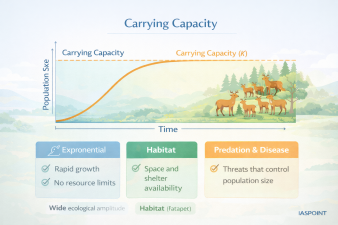
Carrying capacity (K) is defined as the maximum population size of a biological species that a specific environment can sustain indefinitely, given the food, habitat, water, and other available resources. It represents the equilibrium point where the birth rate equals the death rate due to environmental resistance.
Theoretical Framework
In ecological modeling, carrying capacity is the defining feature of the Logistic Growth Model. Unlike exponential growth, which assumes infinite resources, carrying capacity introduces the reality of finite biophysical limits.
- Environmental Resistance: As a population approaches K, factors such as resource depletion, waste accumulation, and increased competition create “resistance,” slowing the rate of growth.
- Mathematical Role: In the logistic equation dtdN=rN(KK−N), the term (K−N)/K acts as a feedback mechanism. When N (population) is small, growth is rapid; as N approaches K, growth drops to zero.
Determinants of Carrying Capacity
Carrying capacity is not a static number; it fluctuates based on several variables:
- Productivity of the Ecosystem: A tropical rainforest has a higher carrying capacity for biomass than a desert due to higher primary productivity.
- Resource Availability: Changes in water supply, soil fertility, or solar radiation directly shift the K value.
- Technology and Innovation: In human contexts, carrying capacity can be artificially expanded through agriculture, desalination, and energy production (though often at the cost of long-term ecological health).
- Consumption Patterns: K is inversely proportional to the per capita resource consumption. If individuals consume more, the total population the environment can support decreases.
Population Dynamics Relative to K
- Overshoot: When a population temporarily exceeds the carrying capacity of its environment.
- Dieback (Crash): A rapid decline in population that occurs after an overshoot, as the degraded environment can no longer support even the original K.
- Degradation: If a population overshoots K significantly, it may damage the resource base (e.g., overgrazing leading to desertification), permanently lowering the future carrying capacity of that region.
Comparison of Growth Limits
| Concept | Description | Impact on Population |
|---|---|---|
| Biotic Potential | Maximum reproductive capacity under ideal conditions. | Leads to Exponential Growth (J-curve). |
| Environmental Resistance | Sum of all limiting factors (predation, food, space). | Curbs growth as density increases. |
| Carrying Capacity (K) | The sustainable ceiling of an ecosystem. | Leads to Logistic Growth (S-curve). |
UPSC Prelims Perspective: Human Carrying Capacity
The study of human carrying capacity often involves the Ecological Footprint.
- Definition: The measure of how much biologically productive land and water an individual or population requires to produce the resources it consumes and to absorb its waste.
- Biocapacity: The actual biological regenerative capacity of a specific area.
- Ecological Deficit: Occurs when the Ecological Footprint of a population exceeds the Biocapacity of the area available to that population.
Trivia and Key Ecological Facts
- The Law of Minimum: Originally proposed by Justus von Liebig, it states that growth is controlled not by the total amount of resources available, but by the scarcest resource (limiting factor), which ultimately dictates the Carrying Capacity.
- Standard of Living: For humans, K is not just about survival but about the “Standard of Living.” A planet that could support 15 billion people at a subsistence level might only support 2 billion at a high-consumption Western standard.
- Cultural Carrying Capacity: A sub-concept where the limit is defined not just by physical survival, but by the maximum population size that can lead a quality life with personal freedom and leisure.