
Strategic Environmental Assessment (SEA) is a systematic process for evaluating the environmental implications of a proposed Policy, Plan, or Programme (PPP). While traditional EIA focuses on individual projects (like a specific dam), SEA operates at a higher level of decision-making to ensure that environmental considerations are integrated into the very foundation of national or regional development strategies.
Key Differences Between EIA and SEA
The distinction between the two lies in the “timing” and the “scale” of the assessment.
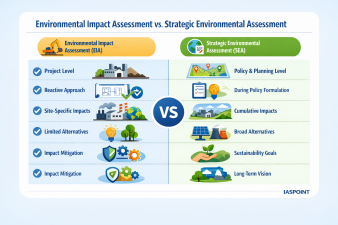
| Feature | Environmental Impact Assessment (EIA) | Strategic Environmental Assessment (SEA) |
| Level | Project-specific (micro level). | Policy, Plan, or Programme (macro level). |
| Timing | Reactive; occurs after a project is designed. | Proactive; occurs during the formulation of a policy. |
| Scope | Site-specific impacts (e.g., local air quality). | Cumulative and synergistic impacts across a region. |
| Alternatives | Limited to site or technology alternatives. | Explores broad strategic alternatives (e.g., Thermal vs. Solar). |
| Focus | Mitigation of negative impacts. | Achievement of sustainability goals. |
Core Objectives of SEA
- Integration of Sustainability: To ensure that environmental, social, and economic factors are balanced at the earliest stage of planning.
- Assessment of Cumulative Impacts: To evaluate the combined effect of multiple projects within a single geographical area (e.g., the total impact of 20 industrial units in a coastal zone).
- Streamlining EIA: By addressing broad issues (like site selection or water allocation) at the SEA level, individual project-level EIAs become faster and more focused.
- Enhancing Governance: SEA promotes transparency and long-term vision in government policies, such as the National National Hydrogen Mission or a State’s Mining Policy.
The SEA Process: A Logical Flow
- Screening: Determining if the proposed policy or plan is likely to have significant environmental effects.
- Scoping: Identifying the environmental objectives and the geographic/temporal boundaries of the assessment.
- Environmental Baseline: Establishing the current state of the environment for the entire region or sector covered by the policy.
- Assessment of Alternatives: Evaluating different strategic options (e.g., “What if we promote electric vehicles instead of expanding highways?”).
- Impact Evaluation: Predicting the broad environmental and social consequences of the preferred policy.
- Mitigation and Monitoring: Suggesting broad measures to prevent degradation and setting up indicators to track the policy’s environmental performance.
Status of SEA in India
Unlike EIA, SEA is not yet a mandatory statutory requirement under Indian law. However, its principles are being increasingly adopted through administrative and judicial routes.
- Draft EIA Notification 2020: Included some elements of “Strategic Assessment” for projects categorized as “Strategic” (though this was criticized for potentially bypassing public scrutiny).
- Regional EIAs: The MoEFCC has occasionally commissioned “Regional Environmental Impact Assessments” for areas like the Western Ghats or the Himalayan river basins, which function similarly to an SEA.
- Judicial Interventions: The Supreme Court and NGT have often directed the government to conduct “Carrying Capacity Studies” before allowing further industrialization in saturated areas (e.g., the Doon Valley or the Pali industrial cluster).
- Sectoral Plans: Policies like the Coastal Regulation Zone (CRZ) and the National Forest Policy implicitly carry the spirit of SEA by setting broad environmental boundaries for all future activities.
Challenges to Implementing SEA in India
- Lack of Legal Framework: Without a specific “SEA Notification,” there is no legal obligation for ministries (like Power, Mining, or Transport) to conduct these assessments.
- Institutional Silos: Different ministries often work in isolation; an SEA requires horizontal coordination between departments like Environment, Water Resources, and Finance.
- Data Gaps: High-level assessments require vast amounts of regional data, which is often fragmented or unavailable.
- Perceived Delay: Policy-makers often fear that SEA will slow down the implementation of “fast-track” economic policies.
Trivia for UPSC Prelims
- The European Union (EU): Was a pioneer in this field, adopting the SEA Directive (2001/42/EC) which makes SEA mandatory for a wide range of public plans and programmes.
- Carrying Capacity: A key concept in SEA, referring to the maximum level of human activity that a particular environment can support without being permanently damaged.
- Cumulative Impact Assessment (CIA): Often considered a subset of SEA, CIA is frequently used in India for “Cascade Hydropower Projects” on the same river to assess the total loss of flow and biodiversity.