

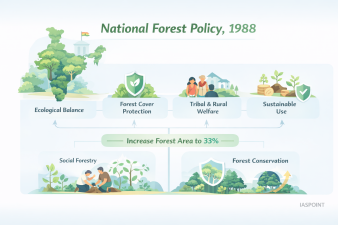
The National Forest Policy (NFP) of 1988 marked a paradigm shift in Indian forest management, moving away from the “revenue generation” focus of the British-era 1952 policy toward “ecological stability” and “community participation.”
- 1894 Policy: Focused on state-controlled commercial exploitation of timber.
- 1952 Policy: Targeted 33% forest cover but prioritized industrial needs and state revenue.
- 1988 Policy: Prioritized environmental stability and the rights of local communities, formalizing the concept of Joint Forest Management (JFM).
Core Objectives of the 1988 Policy
The primary aim is to ensure environmental stability and maintenance of ecological balance, including atmospheric equilibrium which is vital for the sustenance of all life forms.
- Maintenance of Ecological Balance: Conserving the natural heritage of the country by preserving the remaining natural forests.
- Checking Soil Erosion: Denudation in the catchment areas of rivers, lakes, and reservoirs to mitigate floods and droughts.
- Checking Desertification: Preventing the extension of sand dunes in the desert areas of Rajasthan and along coastal tracts.
- Increasing Forest Cover: Massive afforestation and social forestry programs, especially on all denuded, degraded, and unproductive lands.
- Meeting Basic Needs: Increasing the productivity of forests to meet essential national needs such as fuel-wood, fodder, and small timber for rural and tribal populations.
Key Features and Strategic Shifts
Environmental Stability Over Revenue
The 1988 policy explicitly states that the derivation of direct economic benefit must be subordinated to the aim of environmental stability. Forests are no longer viewed primarily as a source of industrial raw materials or state income.
Target Forest Cover
The policy set a national target of maintaining a minimum of one-third (33%) of the total land area of the country under forest or tree cover. In mountainous and hilly regions, the target is higher at two-thirds (66%) to prevent erosion and land degradation.
Rights of Tribal and Local Communities
The policy recognizes the symbiotic relationship between tribal people and forests. It mandates the protection of their customary rights and interests, ensuring that the holders of such rights are involved in forest protection and development.
Essentials of Forest Management
Management of State Forests
No forest-based industry, except at the village or cottage level, should be permitted in the vicinity of forests. Natural forests are to be protected and not diverted for non-forest purposes without rigorous scrutiny.
Diversion of Forest Lands
The policy discourages the diversion of good agricultural land to forest use and vice versa. Any diversion of forest land for non-forest purposes requires compensatory afforestation.
Wildlife Conservation
Special emphasis is placed on the protection and conservation of wildlife, particularly endangered species, through the strengthening of the network of National Parks, Sanctuaries, and Biosphere Reserves.
Comparison: 1952 Policy vs. 1988 Policy
| Feature | National Forest Policy, 1952 | National Forest Policy, 1988 |
| Primary Focus | Production and Revenue | Ecological Stability and Conservation |
| Industrial Role | Encouraged forest-based industries | Discouraged industries near natural forests |
| Community Role | Centralized State Control | Participatory (Joint Forest Management) |
| Timber Usage | Focused on commercial timber | Focused on fuel-wood and fodder for locals |
| Ecology | Secondary to economic growth | Paramount; essential for life support |
Important Facts for UPSC Prelims
- Constitutional Status: Under the 42nd Amendment Act of 1976, ‘Forests’ and ‘Protection of Wild Animals and Birds’ were moved from the State List to the Concurrent List (Seventh Schedule).
- Article 48A (DPSP): The State shall endeavor to protect and improve the environment and to safeguard the forests and wildlife of the country.
- Article 51A(g) (Fundamental Duties): It is the duty of every citizen to protect and improve the natural environment including forests, lakes, rivers, and wildlife.
- Social Forestry: The 1988 policy popularized Social Forestry, which involves the management and protection of forests and afforestation of barren lands with the purpose of helping environmental, social, and rural development.
- Joint Forest Management (JFM): This policy led to the 1990 JFM guidelines, enabling partnership between state forest departments and local communities.
Critical Challenges and Trivia
The 33% Target Gap
Despite the 1988 mandate, India’s current forest cover (as per ISFR 2021) stands at approximately 21.71%, with total forest and tree cover at roughly 24.62%, still short of the 33% goal.
Industrial Raw Material Sourcing
Under the 1988 policy, forest-based industries are encouraged to source their raw materials by entering into direct agreements with small farmers for the supply of wood, rather than relying on state-subsidized forest produce.
Shifting Cultivation (Jhum)
The policy seeks to discourage shifting cultivation by promoting alternative livelihoods and social forestry, recognizing its negative impact on soil fertility and forest density in the North-Eastern states.
Last Modified: April 18, 2026