
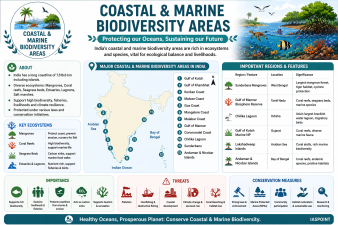
Coastal and Marine Biodiversity Areas (CMBAs) in India are managed through a multi-layered legal framework designed to protect the fragile interface between terrestrial and oceanic ecosystems. These areas encompass mangroves, coral reefs, seagrass beds, salt marshes, and estuaries.
- Primary Legislation: The Wildlife (Protection) Act, 1972, allows for the notification of Marine Protected Areas (MPAs).
- Regulatory Mechanism: The Coastal Regulation Zone (CRZ) Notification, 2018/2019, issued under the Environment (Protection) Act, 1986, categorizes coastal stretches to regulate industrial and developmental activities.
- International Alignment: India is a signatory to the Convention on Biological Diversity (CBD) and adheres to the Aichi Biodiversity Targets, which emphasize the conservation of at least 10% of coastal and marine areas.
Marine Protected Areas (MPAs) in India
India has designated several MPAs to safeguard aquatic flora and fauna. These are broadly classified into National Parks, Sanctuaries, and Conservation Reserves.
| Site Name | State/UT | Ecological Significance |
| Gulf of Mannar Marine National Park | Tamil Nadu | First Marine Biosphere Reserve in South East Asia; famous for Dugongs (Sea Cows). |
| Gahirmatha Marine Sanctuary | Odisha | World’s largest nesting ground for Olive Ridley Turtles (Arribada). |
| Marine National Park (Gulf of Kutch) | Gujarat | India’s first Marine National Park; known for its varied coral reefs and sea cows. |
| Mahatma Gandhi Marine National Park | Andaman & Nicobar | Consists of 15 islands; critical for coral diversity and tropical marine fish. |
| Malvan Marine Sanctuary | Maharashtra | Located in the Sindhudurg district; significant for coral patches and mollusks. |
| Rani Jhansi Marine National Park | Andaman & Nicobar | Unique combination of mangrove threads and coral reefs. |
Critical Coastal Ecosystems
CMBAs are characterized by specific biological builders that provide essential ecosystem services, including storm surge protection and carbon sequestration.
Mangrove Ecosystems
Mangroves act as a “Bio-shield” against cyclones and tsunamis. India hosts approximately 3% of the world’s mangrove vegetation.
- Sundarbans (West Bengal): The largest contiguous mangrove forest in the world and the only one inhabited by tigers.
- Bhitarkanika (Odisha): Famous for Saltwater Crocodiles and the second-largest mangrove ecosystem in India.
- Pichavaram (Tamil Nadu): One of the healthiest mangrove patches, featuring a complex root system of Avicennia and Rhizophora species.
Coral Reefs
Often called the “Rainforests of the Ocean,” coral reefs in India are found in four primary locations:
- Fringing Reefs: Gulf of Mannar, Gulf of Kutch, and Andaman & Nicobar Islands.
- Atolls: Lakshadweep Islands (the only atolls in India).
Important Marine Species for UPSC Prelims
Understanding the flagship species within CMBAs is crucial for environmental geography and ecology sections.
- Dugong (Sea Cow): The only herbivorous mammal that is strictly marine. Found in Gulf of Mannar, Palk Bay, and Andaman Islands. Status: Vulnerable (IUCN).
- Whale Shark: The largest known fish species. Significant populations migrate to the Gujarat coast. Status: Endangered (IUCN).
- Olive Ridley Turtle: Notable for mass nesting. Odisha’s coast (Rushikulya and Gahirmatha) is the most critical global site. Status: Vulnerable (IUCN).
- Humpback Dolphin: Found in shallow coastal waters and estuaries. Status: Endangered/Vulnerable depending on specific subspecies.
Key Threats and Conservation Initiatives
CMBAs face anthropogenic pressures that necessitate rigorous management.
- Threats: Plastic pollution (microplastics), coral bleaching due to rising Sea Surface Temperatures (SST), overfishing, and oil spills.
- Project Dugong: A dedicated conservation program for the Sea Cow.
- Integrated Coastal Zone Management (ICZM) Project: A World Bank-assisted project focused on the sustainable development of coastal resources.
- Blue Flag Certification: An international eco-label for beaches based on 33 stringent criteria. Notable Indian beaches include Golden Beach (Odisha) and Radhanagar (Andaman).
Important Trivia for Aspirants
- Deep Ocean Mission: India’s flagship initiative for underwater exploration and mining of Polymetallic Nodules (PMN) in the Central Indian Ocean Basin.
- Marine Spatial Planning (MSP): India is collaborating with Norway to implement MSP in Lakshadweep and Puducherry to balance ecological integrity with economic growth.
- Coastal Regulation Zone (CRZ) I: The most protected zone, including ecologically sensitive areas like mangroves and coral reefs where no construction is permitted.