
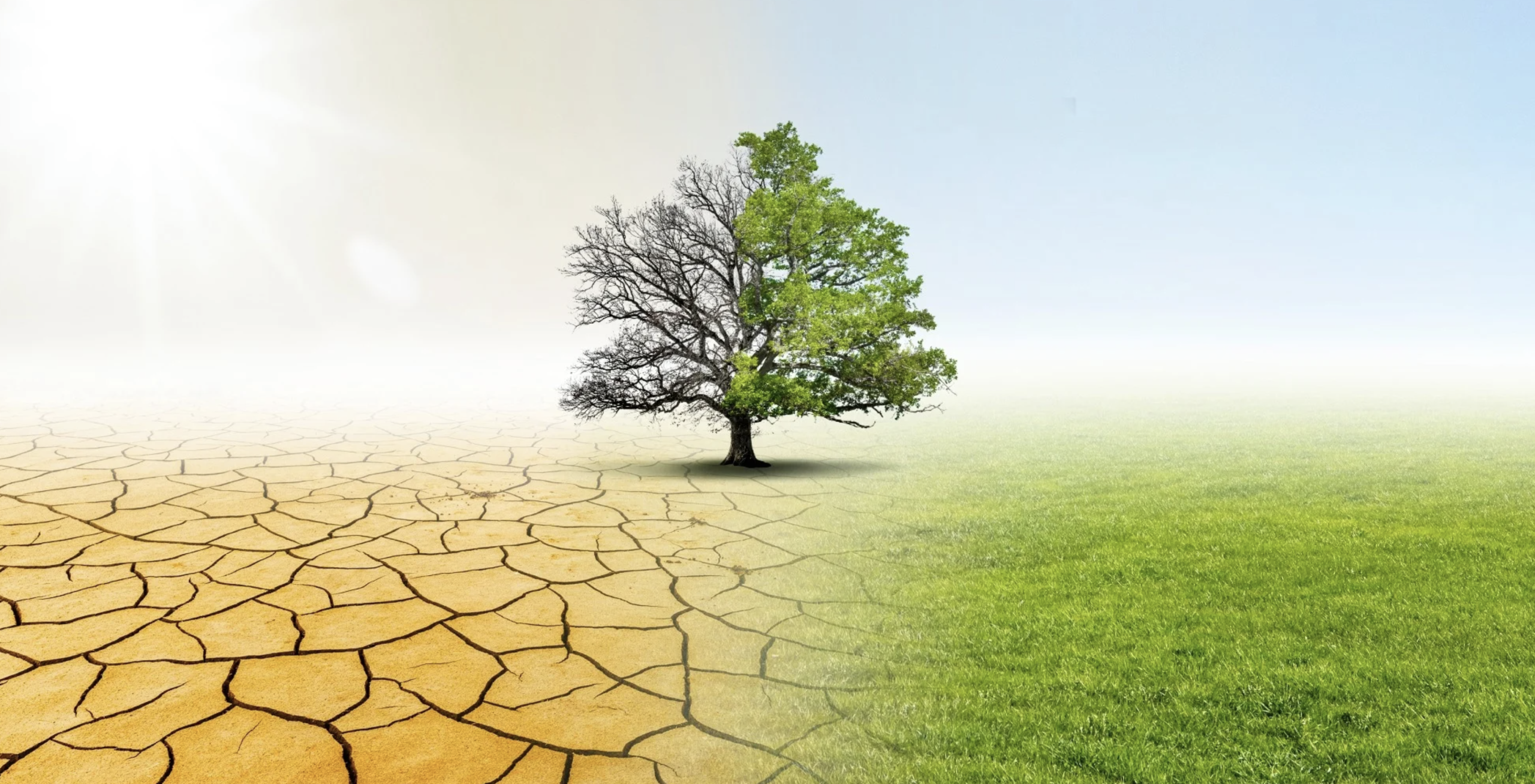
The greenhouse effect is a natural phenomenon that warms the Earth’s surface. Without this process, the Earth’s average temperature would be approximately -18°C, making it inhospitable for most life forms. However, human activities have enhanced this effect, leading to global warming.
The Mechanism of the Greenhouse Effect
The process involves the interaction between solar radiation and the Earth’s atmosphere. It operates through the following steps:
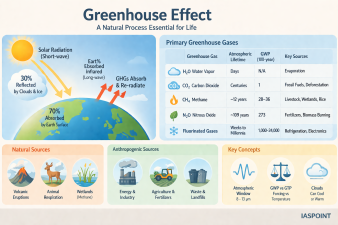
- Solar Radiation Intake: The Sun emits energy primarily as Short-Wave Radiation (Visible light and UV). About 30% of this is reflected back to space by clouds and ice.
- Absorption by Earth: The remaining 70% is absorbed by the Earth’s surface, warming it.
- Terrestrial Radiation: The warmed Earth emits energy back toward space in the form of Long-Wave Radiation (Infrared).
- Atmospheric Trapping: Greenhouse gases (GHGs) in the atmosphere are “transparent” to short-wave solar radiation but “opaque” to long-wave infrared radiation. They absorb this outgoing heat and re-radiate it in all directions, including back to the Earth’s surface.
Primary Greenhouse Gases (GHGs) and their Characteristics
The effectiveness of a GHG depends on its concentration, its atmospheric lifetime, and its Global Warming Potential (GWP).
| Greenhouse Gas | Atmospheric Lifetime | GWP (100-year) | Key Sources |
| Water Vapor (H2O) | Days | N/A | Natural evaporation; most abundant GHG. |
| Carbon Dioxide (CO2) | Centuries | 1 | Respiration, Deforestation, Fossil fuel combustion. |
| Methane (CH4) | ~12 years | 28–36 | Wetlands, Livestock, Paddy fields, Fugitive emissions. |
| Nitrous Oxide (N2O) | ~109 years | 273 | Fertilizer use, Biomass burning, Industrial processes. |
| Fluorinated Gases | Weeks to Millennia | 1,000–24,000 | Refrigeration, ACs, Semiconductor manufacturing. |
Major Natural vs. Anthropogenic Sources
Natural Sources
- Volcanic Eruptions: Release CO2 and water vapor.
- Animal Respiration: Contributes to the carbon cycle.
- Wetlands: The largest natural source of methane due to anaerobic decomposition.
Anthropogenic (Human) Sources
- Energy Sector: The largest contributor, primarily through CO2 from coal and gas.
- Agriculture: Rice paddies and enteric fermentation (Methane); Nitrogenous fertilizers (Nitrous Oxide).
- Deforestation: Reduces the “carbon sink” capacity and releases stored carbon during burning.
- Waste Management: Landfills and wastewater treatment plants emit significant quantities of methane.
Critical Concepts for UPSC Prelims
The Greenhouse Window
The “Atmospheric Window” refers to a specific range of infrared wavelengths (roughly 8 to 13 micrometers) where the atmosphere is relatively transparent, allowing heat to escape directly into space. Certain synthetic GHGs (like CFCs) are particularly dangerous because they absorb energy within this specific window that other gases do not cover.
Global Warming Potential (GWP) vs. Global Temperature Change Potential (GTP)
- GWP: Measures the total energy absorbed by a gas over a specific time period (usually 100 years) relative to CO2. It focuses on the integrated radiative forcing.
- GTP: Measures the change in global mean surface temperature at a specific point in time (e.g., at year 100) relative to CO2. It is considered a more “outcome-based” metric.
Clouds and the Greenhouse Effect
Clouds play a dual role. They have a cooling effect by reflecting incoming solar radiation (Albedo effect) and a warming effect by trapping outgoing infrared radiation (Greenhouse effect). High-altitude cirrus clouds generally contribute to warming, while low-altitude stratus clouds generally contribute to cooling.
Global and National Initiatives
- Kyoto Protocol (1997): The first international treaty to mandate GHG emission reductions. It identified six main GHGs: CO2, CH4, N2O, HFCs, PFCs, and SF6.
- Kigali Amendment (2016): An amendment to the Montreal Protocol aimed at phasing down Hydrofluorocarbons (HFCs), which are potent GHGs used as replacements for ozone-depleting substances.
- India’s Green Hydrogen Mission: Aimed at reducing reliance on fossil fuels in “hard-to-abate” sectors (Steel, Refineries) to lower CO2 output.