

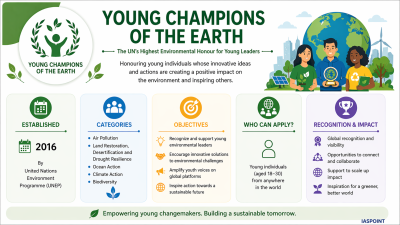
The Young Champions of the Earth is the United Nations Environment Programme’s (UNEP) flagship youth engagement initiative. Launched in 2017, it is designed to identify, support, and celebrate environmental entrepreneurs aged 18 to 30 who have big ideas to protect or restore the environment.
Institutional Profile and Framework
Genesis and Purpose
- Established: 2017 by UNEP.
- Objective: To provide young environmental leaders with the resources, mentorship, and platform required to scale their innovative solutions for the “Triple Planetary Crisis” (climate change, biodiversity loss, and pollution).
- Nature: A global competition and incubator program for early-stage environmental ventures.
Eligibility and Selection Criteria
- Age Limit: Applicants must be between 18 and 30 years old at the end of the calendar year.
- Experience: The project or idea must have been implemented for at least six months prior to application.
- Geographic Scope: Open to citizens of all countries.
- Evaluation Pillars: Applications are judged on Innovation, Scalability, Feasibility, and the applicant’s Impact Potential.
The 2026 Cycle: Focus and Timeline
As of April 2026, the program is in the evaluation phase following the closure of nominations.
- Thematic Focus: Aligned with the senior “Champions of the Earth” award, the 2026 cycle emphasizes Ocean Health (restoration, pollution prevention, and sustainable coastal livelihoods).
- Nomination Window: Open from February 24 to March 31, 2026.
- Selection Process: Finalists undergo a rigorous review by global experts, culminating in a high-level pitch competition.
Award Benefits and Support System
Laureates of the Young Champions program receive a comprehensive support package to transform their ideas into viable businesses or movements.
| Benefit | Description |
| Seed Funding | Winners typically receive $10,000 to 20,000</b> in initial funding.</td> </tr> <tr> <td><b>Pitch Opportunity</b></td> <td>Participation in a global pitch competition (often in <b>New York</b>) with a chance for additional grants (up to100,000) and seed investments. |
| Mentorship | Tailored training and capacity-building from environmental and business experts. |
| Global Platform | High-level visibility at UN events and through global media coverage. |
| Networking | Access to a community of like-minded innovators and potential investors. |
Indian Success Stories: Recent Laureates
India has consistently produced “Young Champions,” highlighting the country’s vibrant ecosystem for environmental startups.
Jinali Mody (2025 Laureate)
- Venture: Founder of Banofi Leather.
- Innovation: Converts banana crop waste into a high-quality, plant-based leather alternative.
- Impact: Reduces water use by 95% and carbon emissions by 90% compared to animal leather. It provides an additional income stream for smallholder farmers and is a women-led enterprise (60% female workforce).
Vidyut Mohan (2020 Laureate)
- Venture: Co-founder of Takachar.
- Innovation: Small-scale, portable technology that converts agricultural waste (biomass) into marketable products like fuel and fertilizer.
- Impact: Directly addresses stubble burning in Northern India, a major contributor to winter air pollution.
Strategic Partnerships
- Planet A: In 2025–2026, the program partnered with Chris Kemper (UNEP Advocate for Partnerships) and the YouTube channel Planet A to enhance environmental awareness and provide a more robust financial runway for winners.
- Investment Focus: Recent cycles have shifted toward the Circular Economy, rewarding ventures that treat wastewater, tackle plastic pollution, or create sustainable alternatives to conventional materials.
Essential Trivia for UPSC Prelims
- Frequency: The award is given annually, but the program underwent a “re-launch” in 2025 with expanded funding and a more intensive pitch-based selection model.
- Scope: Only seven winners are selected globally each year (one from each of the six UN regions: Africa, Asia and the Pacific, Europe, Latin America and the Caribbean, North America, and West Asia, plus an additional winner).
- Proof of Concept: Unlike many youth grants, this award requires a “proof of concept” or measurable progress; it is not for purely theoretical ideas.
- Triple Planetary Crisis: A recurring term in Young Champions citations, referring to the three main environmental threats the UN seeks to mitigate through youth innovation.