
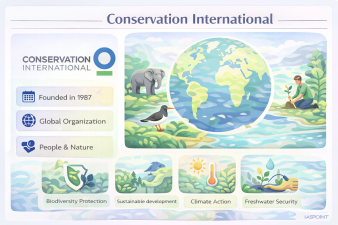
Conservation International is an American non-profit environmental organization headquartered in Arlington, Virginia. Since its inception, CI has been at the forefront of science-driven conservation, focusing on the link between a healthy planet and human well-being.
Institutional Framework and Philosophy
Origin and Evolution
- Establishment: Founded in 1987 by Peter Seligmann and Spencer Beebe.
- Mission: To empower societies to responsibly and sustainably care for nature, our global biodiversity, for the well-being of humanity.
- Unique Philosophy: Unlike organizations that focus solely on wildlife, CI operates on the premise that “Nature doesn’t need people, people need nature.” It emphasizes the ecosystem services that nature provides, such as clean water, food, and climate regulation.
Key Conservation Concepts Pioneered by CI
Biodiversity Hotspots
While the concept was originally proposed by British ecologist Norman Myers in 1988, Conservation International adopted it as a primary conservation blueprint.
- Criteria for a Hotspot:
- Species Endemism: It must contain at least 1,500 species of vascular plants ( > 0.5% of the world’s total) as endemics.
- Degree of Threat: It has to have lost at least 70% of its original native vegetation.
- Current Status: There are currently 36 recognized Biodiversity Hotspots globally. They cover only 2.5% of Earth’s land surface but support over 50% of the world’s endemic plant species and nearly 43% of endemic bird, mammal, reptile, and amphibian species.
High-Biodiversity Wilderness Areas (HBWAs)
To balance the focus on threatened areas (hotspots), CI identified HBWAs to protect large, intact ecosystems.
- Criteria: Areas of at least 10,000 sq. km that are at least 70% intact and have high concentrations of endemic species.
- Major HBWAs: The Amazon Basin, the Congo Basin, New Guinea, the North American Deserts, and the Miombo-Mopane Woodlands.
Global Initiatives and Tools
| Initiative | Description | Significance |
| Critical Ecosystem Partnership Fund (CEPF) | A joint initiative of CI, l’Agence Française de Développement, the EU, the GEF, the Government of Japan, and the World Bank. | Provides grants to NGOs and private sector partners to protect biodiversity hotspots. |
| Ocean Health Index (OHI) | A scientific framework used to measure the health of the world’s oceans. | Evaluates oceans based on 10 goals, including biodiversity, carbon storage, and livelihoods. |
| Blue Carbon Initiative | A global program working to mitigate climate change through the restoration and sustainable use of coastal and marine ecosystems. | Focuses on mangroves, tidal marshes, and seagrasses as highly efficient carbon sinks. |
| Vital Signs | An integrated monitoring system that generates data on agriculture, nature, and human well-being. | Helps African farmers and policymakers make informed decisions to increase food security. |
Conservation International and India
Biodiversity Hotspots in India
CI’s hotspot framework identifies four regions that fall partially or fully within India:
- The Himalayas: Includes the entire Indian Himalayan region.
- The Western Ghats and Sri Lanka: Includes the entire Western Ghats mountain chain.
- Indo-Burma: Includes Purvanchal Hills, Arakan Yoma, and the Eastern Himalayas (South of the Brahmaputra).
- Sundaland: Includes the Nicobar group of Islands (and parts of SE Asia).
Strategic Interventions
- CEPF in the Western Ghats: CI, through the CEPF, has provided millions of dollars in grants to local Indian NGOs for the conservation of endemic species and the restoration of corridors in the Western Ghats.
- Sustainable Landscapes: Working on projects that promote sustainable coffee and spice production in the Western Ghats to ensure economic viability without compromising biodiversity.
Essential Trivia for UPSC Prelims
- Mega-biodiverse Countries: CI identified 17 “megadiverse” countries (including India) that house the majority of Earth’s species and a high number of endemics.
- Debt-for-Nature Swaps: CI was one of the early pioneers of this financial mechanism, facilitating the first-ever swap in Bolivia in 1987.
- Arlington Core: CI is known for its “Rapid Assessment Program” (RAP), where scientists conduct quick surveys of poorly known areas to determine their biological importance.
- Nature Is Speaking: A high-profile film series launched by CI where celebrities voice different elements of nature (e.g., Julia Roberts as Mother Nature, Harrison Ford as The Ocean) to raise public awareness.
Comparison: CI vs. WWF
| Feature | Conservation International (CI) | World Wide Fund for Nature (WWF) |
| Focus | Human well-being through nature conservation. | Species protection and reducing human footprint. |
| Blueprint | Biodiversity Hotspots and HBWAs. | The “Global 200” Ecoregions. |
| Strategy | Heavily science and data-driven; corporate partnerships. | Grassroots movements, global campaigns (Earth Hour). |
| Core Idea | Ecosystem Services (Nature’s value to humans). | Biodiversity conservation for its intrinsic value. |