

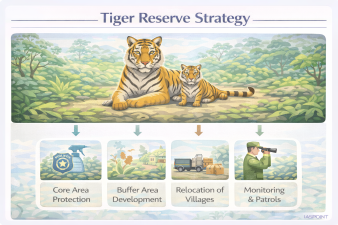
The management of Tiger Reserves in India is governed by the National Tiger Conservation Authority (NTCA) under the framework of Project Tiger. The strategy has shifted from isolated protected areas to a landscape-based conservation approach, integrating legal, ecological, and technological dimensions.
Legal and Administrative Architecture
The Tiger Conservation Plan (TCP)
Under Section 38V of the Wildlife (Protection) Act, 1972, every state government must prepare a Tiger Conservation Plan for each reserve.
- Objective: To ensure the protection of the tiger reserve and the “inviolate” nature of the core area.
- Components: It includes strategies for habitat improvement, anti-poaching, and the socioeconomic development of forest-dwelling communities.
Administrative Bodies
- National Tiger Conservation Authority (NTCA): A statutory body providing normative standards and technical support.
- State Level Steering Committee: Chaired by the Chief Minister to ensure inter-sectoral coordination.
- Tiger Conservation Foundation (TCF): A state-level trust that allows reserves to retain and use revenue (like tourism fees) directly for local conservation and staff welfare.
Spatial Strategy: The Zonal Model
Tiger reserves are divided into two distinct functional zones to manage the conflict between conservation and human presence.
| Feature | Core Area (Critical Tiger Habitat) | Buffer / Peripheral Area |
| Legal Basis | Notified under WPA 1972 | Notified under Section 38V of WPA |
| Human Activity | Strictly Inviolate; no human habitation | Limited; allows for “co-existence” |
| Primary Goal | Tiger breeding and survival | Habitat supplement and corridor protection |
| Rights | Voluntary relocation of dwellers | Recognition of Forest Rights (FRA 2006) |
The Landscape Approach and Connectivity
The strategy recognizes that tigers require large home ranges. Conservation is now planned across five major landscapes:
- Shivalik Hills & Gangetic Plains
- Central India & Eastern Ghats
- Western Ghats
- North Eastern Hills & Brahmaputra Flood Plains
- Sundarbans
Tiger Corridors
India has identified 32 major tiger corridors. The strategy involves keeping these corridors functional to prevent “genetic bottlenecking” by allowing tigers to move between reserves, such as the Kanha-Pench Corridor.
Technological Interventions in Monitoring
M-STrIPES (Monitoring System for Tigers – Intensive Protection and Ecological Status)
This is a software-based system used by forest guards for:
- Patrol Module: Real-time tracking of foot patrols and geotagging of poaching signs or snare removals.
- Ecological Module: Standardized recording of sightings of tigers, prey base (ungulates), and habitat changes.
Modern Surveillance
- e-Eye: A 24/7 intelligent surveillance system using thermal cameras mounted on high towers (extensively used in Jim Corbett and Kaziranga).
- Conservation Assured | Tiger Standards (CA|TS): An international accreditation tool that sets best practices for tiger site management. Currently, several Indian reserves, including Manas, Kaziranga, and Orang, are CA|TS accredited.
Community-Based Conservation Strategy
- Relocation Policy: The government provides a compensation package (currently ₹15 Lakhs per family) for voluntary relocation from core areas to create “inviolate” spaces.
- Eco-Development Committees (EDCs): These involve local villagers in tourism and protection tasks to reduce their dependency on forest resources like fuelwood and grazing.
- Special Tiger Protection Force (STPF): Local youth, particularly from traditional hunting communities, are often recruited into these specialized anti-poaching units.
Strategic Challenges and Recent Trends
- Human-Wildlife Conflict (HWC): As tiger numbers increase, they frequently venture into human-dominated landscapes. Strategy now focuses on Rapid Response Teams (RRTs) and solar fencing.
- Invasive Species: Management of weeds like Lantana camara which suppress native grasses needed for the tiger’s prey base.
- Linear Infrastructure: Mitigation measures like Animal Underpasses and Overpasses on highways (e.g., NH-44 passing through Pench) are now mandatory for projects passing through tiger habitats.