
Pollinators—including insects (bees, butterflies, moths), birds, and bats—are essential for the reproduction of nearly 90% of wild flowering plants and 75% of global food crops. The IPBES Assessment Report on Pollinators (2016) warned of a global decline in pollinator abundance and diversity, a phenomenon often termed the “Pollinator Crisis.” This decline poses a direct threat to global food security, ecosystem stability, and human nutrition.
Classification of Pollinators
Pollinators are broadly categorized into two groups, with insects being the most significant contributors to agricultural productivity.
| Category | Key Examples | Special Features |
| Invertebrate (Insects) | Honeybees, Bumblebees, Butterflies, Moths, Beetles, Hoverflies. | Honeybees are the most efficient; moths are critical for nocturnal pollination. |
| Vertebrate | Bats, Birds (Sunbirds, Hummingbirds), Rodents, some Primates. | Birds are key for red, tubular flowers; bats pollinate high-value crops like Agave and Durian. |
Major Drivers of Decline
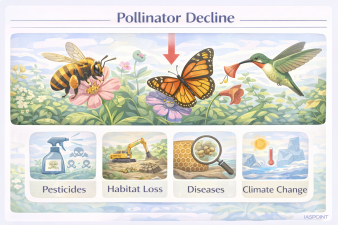
The decline is rarely caused by a single factor but is a result of cumulative “anthropogenic” pressures.
- Habitat Fragmentation & Loss: Conversion of diverse grasslands and forests into intensive monocultures reduces nesting sites and floral diversity.
- Pesticide Exposure: Extensive use of Neonicotinoids (systemic insecticides) causes lethal and sub-lethal effects, impairing bees’ navigation, foraging, and immune systems.
- Climate Change: Causes phenological mismatch, where the timing of flowering no longer aligns with the emergence of pollinators.
- Pathogens & Invasive Species: Global trade has facilitated the spread of diseases (e.g., Varroa mites in bees) and invasive species (e.g., Asian Giant Hornet) that outcompete or prey on native pollinators.
- Electromagnetic Radiation: Emerging research suggests that radiation from mobile towers may interfere with the magnetoreception of honeybees, leading to Colony Collapse Disorder (CCD).
Impact on Food Security and Economy
Pollination is a “regulating ecosystem service” with immense economic value, estimated between $235 billion and $577 billion annually.
- Nutritional Deficit: Pollinator-dependent crops (fruits, vegetables, nuts) provide the bulk of essential micronutrients (Vitamin A, C, and Folic Acid). Their decline leads to “hidden hunger.”
- Crop Yield Variability: Without animal pollinators, yields of high-value crops like Coffee, Cocoa, Almonds, and Apples would plummet.
- India-Specific Impact: India is the world’s largest producer of pulses and various fruits; a decline in honeybee populations (like the Indian Honeybee Apis cerana indica) directly impacts the income of smallholder farmers.
Global and National Initiatives
International frameworks and local innovations are being deployed to halt the decline.
International Initiatives
- International Pollinators Initiative (IPI): Established in 2000 under the Convention on Biological Diversity (CBD) and led by the FAO. Its Plan of Action (2018–2030) focuses on mainstreaming pollinator conservation into agriculture.
- Promote Pollinators (Coalition of the Willing): A group of nations committed to implementing the IPBES findings through national strategies.
- Kunming-Montreal Global Biodiversity Framework (2022): Target 11 specifically aims to restore and maintain ecosystem services, including pollination.
Indian Context & 2026 Updates
- National Beekeeping and Honey Mission (NBHM): A central sector scheme under the “Sweet Revolution” to promote scientific beekeeping for both honey and pollination services.
- NHAI ‘Bee Corridors’ (2026): A first-of-its-kind initiative by the National Highways Authority of India to plant pollinator-friendly “ecological corridors” along highways. These include nectar-rich trees like Neem, Karanj, Mahua, and Palash to support trans-regional pollinator movement.
- Draft Pesticides Management Bill (2025): Seeks to regulate highly toxic pesticides and promote “Green Chemistry” to reduce non-target mortality of beneficial insects.
UPSC Prelims: Critical Facts and Trivia
- Waggle Dance: A unique communication method used by honeybees to share the location of food sources with the colony.
- Floral Fidelity: The tendency of a pollinator to visit only one plant species during a foraging trip, which increases pollination efficiency.
- Colony Collapse Disorder (CCD): A phenomenon where the majority of worker bees in a colony disappear, leaving behind the queen and plenty of food; primarily linked to North American and European honeybee populations.
- Major Crops Independent of Pollinators: Staple cereals like Wheat, Rice, and Maize are wind-pollinated or self-pollinated and do not require insects.
- Economic Trivia: In some parts of China, extreme pollinator decline has forced farmers to perform “hand-pollination” of apple blossoms using brushes.