
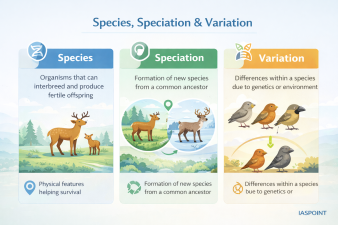
A Species is the fundamental unit of biological classification. It is defined as a group of organisms that share similar morphological, anatomical, and physiological traits and are capable of interbreeding under natural conditions to produce fertile offspring.
- Reproductive Isolation: This is the primary criterion for defining a species. Even if two different species are similar (e.g., Horse and Donkey), their offspring (Mule) is usually sterile, confirming they are separate species.
- Genetic Integrity: Members of a species share a common gene pool, which is maintained through interbreeding.
Speciation: The Formation of New Species
Speciation is the evolutionary process by which populations evolve to become distinct species. It occurs when a population is split and reproductive isolation develops between the groups.
Types of Speciation
| Type | Mechanism | Key Feature |
| Allopatric | Physical barrier (mountains, rivers, oceans) splits a population. | Geographical isolation leads to genetic divergence. |
| Sympatric | New species evolve from a single ancestral species while inhabiting the same geographic region. | Often due to polyploidy (extra sets of chromosomes) or sudden niche shifts. |
| Parapatric | Populations are separated by an extreme change in habitat rather than a physical barrier. | Species are adjacent; they may interbreed in a small “hybrid zone.” |
| Peripatric | A small group breaks off from the larger population to occupy a new peripheral niche. | Founder effect plays a major role in genetic drift. |
Variation: The Raw Material of Evolution
Variation refers to the differences that exist between individuals of the same species. Without variation, natural selection would have no “choices” to make, and evolution would stall.
Sources of Variation
- Mutation: Sudden, permanent changes in the DNA sequence. They are the ultimate source of new genetic material.
- Recombination: Occurs during meiosis (cell division) where genetic material is shuffled between chromosomes, creating new combinations in offspring.
- Gene Flow: The transfer of genetic material from one population to another through migration.
- Genetic Drift: Random changes in gene frequencies, particularly influential in small populations (e.g., Bottleneck effect).
Natural Selection and Survival
Proposed by Charles Darwin, Natural Selection is the process whereby organisms better adapted to their environment tend to survive and produce more offspring.
- Stabilizing Selection: Favors average individuals (e.g., human birth weight).
- Directional Selection: Favors one extreme phenotype (e.g., antibiotic resistance in bacteria).
- Disruptive Selection: Favors both extremes, often leading to speciation.
Important Ecological Terms for UPSC
1. Endemic Species
Species found only in a specific geographical area and nowhere else in the world (e.g., the Lion-tailed Macaque in the Western Ghats or the Sangai Deer in Manipur). These are highly vulnerable to extinction.
2. Invasive Alien Species (IAS)
Species introduced (accidentally or intentionally) to a new region where they outcompete native species and disrupt the ecosystem (e.g., Water Hyacinth, Lantana camara, and Prosopis juliflora in India).
3. Indicator Species
Species whose presence, absence, or abundance reflects a specific environmental condition.
- Lichens: Indicators of air quality (especially SO2 levels).
- Frogs: Indicators of wetland health due to their permeable skin.
4. Foundation Species
A dominant primary producer in an ecosystem that provides the fundamental structure for the community (e.g., Coral polyps in a reef or Kelp in underwater forests).
Summary Checklist for Prelims
- Evolutionary Convergence: When unrelated species evolve similar traits because they live in similar environments (e.g., wings of birds and bats).
- Evolutionary Divergence: When related species evolve different traits to adapt to different niches (e.g., Darwin’s Finches).
- Reproductive Barrier Types: Pre-zygotic (before fertilization, like different mating seasons) and Post-zygotic (after fertilization, like hybrid sterility).