
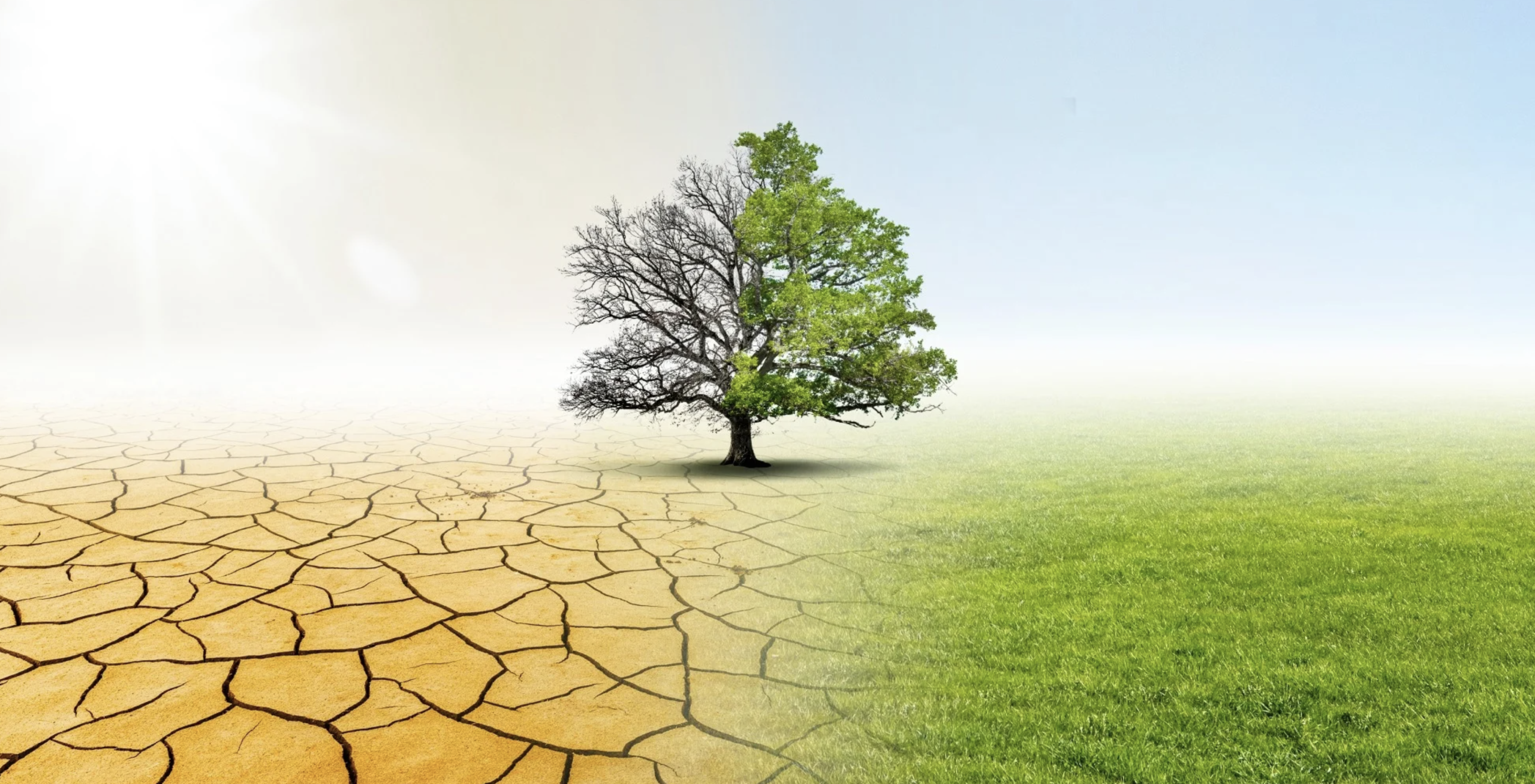
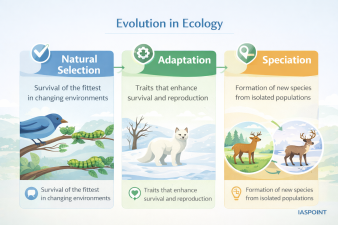
Evolution is the change in the heritable characteristics of biological populations over successive generations, driven by the environment acting as the ultimate “selective pressure.”
Forces Driving Evolutionary Change
Evolution is governed by four primary mechanisms that determine the genetic fitness of a population within an ecosystem.
1. Natural Selection
Proposed by Charles Darwin, this is the differential survival and reproduction of individuals due to differences in phenotype.
- Concept of Fitness: In ecology, fitness is measured by an organism’s ability to survive, find a mate, and produce fertile offspring.
- Industrial Melanism: A classic example where the Peppered Moth (Biston betularia) in England evolved from light to dark colors to survive on soot-covered trees during the Industrial Revolution.
2. Genetic Drift
Random changes in the frequency of gene variants (alleles) in a population. It is more pronounced in small populations.
- Population Bottleneck: Occurs when a population’s size is reduced for at least one generation (e.g., due to a natural disaster), leading to reduced genetic diversity.
- Founder Effect: Occurs when a new colony is started by a few members of the original population (e.g., birds blown to an isolated island).
3. Gene Flow (Migration)
The transfer of genetic material from one population to another. It increases genetic variation within a population but decreases differences between populations.
4. Mutation
The primary source of all new genetic variation. Mutations provide the “raw material” upon which natural selection acts.
Patterns of Evolution
Ecology observes how different species respond to environmental challenges through distinct evolutionary trajectories.
| Pattern | Description | Key Example |
| Convergent Evolution | Unrelated species evolve similar traits to adapt to similar environments. | Streamlined bodies of Sharks (fish) and Dolphins (mammals). |
| Divergent Evolution | Related species evolve different traits due to different environmental pressures. | Darwin’s Finches evolving different beak shapes for different food sources. |
| Co-evolution | Two species evolve in response to changes in each other. | Orchids and their specific moth pollinators; Predator-Prey “Arms Race.” |
| Parallel Evolution | Related species evolve similar traits independently while living in isolated but similar environments. | Marsupial mammals (Australia) and Placental mammals (North America). |
Adaptive Radiation
This is a specific type of divergent evolution where a single ancestral species rapidly diversifies into many new forms to fill vacant ecological niches.
- Context: This typically occurs after a mass extinction or when a species reaches a new, isolated geographical area (e.g., the diversification of mammals after the extinction of dinosaurs).
Key Evolutionary Concepts and Rules
1. Homologous vs. Analogous Organs
- Homologous Organs: Different functions but similar internal structure/origin (e.g., human hand, whale flipper, bat wing). These indicate Common Ancestry.
- Analogous Organs: Similar functions but different internal structure/origin (e.g., wings of a butterfly and wings of a bird). These indicate Convergent Evolution.
2. The Red Queen Hypothesis
Proposed by Leigh Van Valen, it states that species must “run” (evolve) as fast as they can just to stay in the same place (survive). It emphasizes that the environment—including competing species—is constantly changing.
3. Speciation and Extinction
- Speciation: The formation of new and distinct species in the course of evolution (Allopatric, Sympatric, etc.).
- Mass Extinction: Occurs when at least 75% of all species go extinct in a geologically short period. Earth has witnessed five major mass extinctions, with scientists suggesting we are currently in the Sixth Extinction (Anthropocene).
Important Facts for UPSC Prelims
- Vestigial Organs: Organs that have lost their original function through evolution (e.g., human appendix, pelvic bone of whales).
- Hardy-Weinberg Principle: A mathematical model stating that allele frequencies remain constant in a population in the absence of evolutionary influences.
- Phyletic Gradualism vs. Punctuated Equilibrium: Gradualism suggests slow, steady change; Punctuated Equilibrium suggests long periods of stasis broken by rapid bursts of speciation.
- Endemic Evolution: Occurs in isolated hotspots (like the Western Ghats or Galapagos), leading to high concentrations of species found nowhere else.