
Population growth refers to the increase in the number of individuals in a population over a specific period. In ecology, this is determined by the interplay between the biotic potential of a species and the environmental resistance it encounters.
Determinants of Population Change
The size of a population (N) is influenced by four primary demographic factors. The population density at time t+1 is calculated using the formula:
- Natality (B): The number of births in a population during a given period.
- Mortality (D): The number of deaths in a population during a given period.
- Immigration (I): The number of individuals of the same species that have come into the habitat from elsewhere.
- Emigration (E): The number of individuals who left the habitat during the time period.
Population Growth Models
Ecologists use two primary models to describe how populations grow based on resource availability.
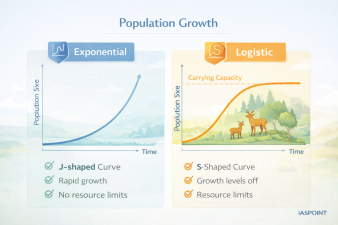
Exponential Growth (J-shaped Curve)
This occurs when resources (food, space) in a habitat are unlimited.
- Characteristics: The population increases in a geometric or exponential fashion.
- Mathematical Expression: dN/dt = rN, where r is the intrinsic rate of natural increase.
- Observation: This is often seen in algal blooms or bacterial growth in a fresh culture. It is usually unsustainable in nature and leads to a sudden “crash” once resources are exhausted.
Logistic Growth (S-shaped or Sigmoid Curve)
This is a more realistic model where resources are finite.
- Carrying Capacity (K): The maximum number of individuals of a particular species that a given environment can support sustainably.
- Characteristics: The population grows rapidly at first (Lag phase and Log phase), then slows down as it approaches the carrying capacity (Deceleration phase), eventually reaching an equilibrium (Stationary phase).
- Mathematical Expression: The Verhulst-Pearl Logistic Equation:dN/dt = rN ( K – N/K )
- Significance: The term (K-N)/K represents environmental resistance.
Reproductive Strategies: r-Selection vs. K-Selection
Species have evolved different strategies to maximize their fitness based on environmental stability.
| Feature | r-strategists (Opportunistic) | K-strategists (Equilibrium) |
| Environment | Unstable, unpredictable | Stable, predictable |
| Body Size | Generally small | Generally large |
| Offspring | Many, small size | Few, large size |
| Parental Care | Little to none | High investment |
| Lifespan | Short | Long |
| Examples | Insects, weeds, bacteria, rodents | Elephants, humans, whales, oaks |
Factors Regulating Population Growth
Population density is controlled by two types of limiting factors:
Density-Dependent Factors
These factors have a greater impact as the population density increases.
- Competition: For food, territory, and mates (Intraspecific competition).
- Predation: Higher prey density attracts more predators.
- Disease: Pathogens spread more easily in crowded populations.
Density-Independent Factors
These factors affect the population regardless of its size or density.
- Natural Disasters: Floods, fires, earthquakes, and droughts.
- Climatic Shifts: Sudden freezes or heatwaves.
- Anthropogenic Factors: Use of pesticides or habitat destruction.
UPSC Prelims Trivia and Key Concepts
- Biotic Potential: The maximum reproductive capacity of an organism under optimal environmental conditions. It is restricted by environmental resistance.
- Doubling Time: The time taken for a population to double in size at a constant growth rate. It is calculated using the “Rule of 70” (70 divided by the percentage growth rate).
- Population Oscillation: Some populations do not stay at K but fluctuate in cycles (e.g., the 10-year cycle of the Lynx and Snowshoe Hare).
- Allee Effect: A phenomenon where population growth rate decreases as the density gets very low (inverse of density dependence). This is common in social animals that need a “critical mass” for protection or finding mates.