

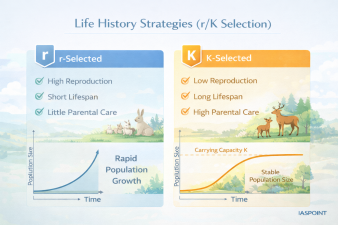
In ecology, life history strategies refer to the suite of traits shaped by natural selection that determine how an organism allocates its limited time and energy toward survival, growth, and reproduction. The most prominent framework for understanding these trade-offs is the r/K selection theory, developed by Robert MacArthur and E.O. Wilson.
r-Selection: The Opportunistic Strategy
The “r” stands for the intrinsic rate of natural increase. These organisms are adapted to exploit unstable or unpredictable environments where rapid growth is advantageous.
- Environmental Context: Found in disturbed habitats or early successional stages (e.g., after a forest fire or in a temporary pond).
- Reproductive Tactics: They produce a large number of offspring, but invest very little energy in each individual.
- Survival Pattern: High mortality rates among the young (Type III survivorship curve).
- Population Dynamics: Usually follow a “Boom and Bust” cycle; populations can grow exponentially and then crash suddenly.
- Key Traits: Small body size, early maturity, short generation time, and wide dispersal of offspring.
K-Selection: The Equilibrium Strategy
The “K” stands for Carrying Capacity. These organisms are adapted to compete for limited resources in stable, predictable environments.
- Environmental Context: Found in stable ecosystems like climax forests (e.g., tropical rainforests) or stable marine environments.
- Reproductive Tactics: They produce few offspring but invest heavily in parental care to ensure a high probability of survival.
- Survival Pattern: Low mortality in early life; most individuals live to an old age (Type I or Type II survivorship curve).
- Population Dynamics: Population size is stable and remains near the carrying capacity (K) of the environment.
- Key Traits: Large body size, late maturity, long life expectancy, and repeated reproductive episodes (iteroparity).
Comparative Analysis of r and K Strategies
| Feature | r-Strategists | K-Strategists |
| Primary Goal | Rapid Colonization | Competitive Ability |
| Offspring Number | Many (High fecundity) | Few (Low fecundity) |
| Parental Care | Absent or Minimal | Significant/Long-term |
| Development | Rapid | Slow |
| Body Size | Small | Large |
| Niche Type | Generalists | Often Specialists |
| Succession Stage | Pioneer Species | Climax Species |
| Examples | Bacteria, Insects, Weeds, Dandelions | Elephants, Whales, Humans, Oak trees |
Survivorship Curves
Life history strategies are closely linked to how survival probability changes with age.
- Type I (K-selection): High survival probability in early and middle life, followed by a rapid decline in later life (e.g., Humans, Large Mammals).
- Type II (Intermediate): Constant mortality rate regardless of age (e.g., Birds, some Lizards).
- Type III (r-selection): Extremely high mortality at young ages, but those that reach adulthood have a good chance of surviving for a significant period (e.g., Fish, Oysters, many Insects).
Trade-offs in Life History
Organisms cannot maximize all life history traits simultaneously due to energy constraints.
- Quantity vs. Quality: Producing more offspring (r-strategy) necessitates less energy per offspring, reducing their individual chance of survival.
- Current vs. Future Reproduction: Species must “decide” whether to breed early and die (semelparity) or save energy to breed multiple times over a lifetime (iteroparity).
- Semelparity: “Big Bang” reproduction; a single reproductive event before death (e.g., Pacific Salmon, Bamboo).
- Iteroparity: Multiple reproductive cycles over the course of a lifetime (e.g., Perennial plants, most Vertebrates).
UPSC Prelims Fact File
- The Continuum: In reality, r and K selection are two ends of a spectrum. Most species fall somewhere in between (e.g., Sea turtles produce many eggs like r-strategists but live long lives like K-strategists).
- Environmental Disturbance: Frequent disturbances favor r-selected species. Conservation efforts often struggle because endangered species are typically K-selected (slow to recover), while invasive pests are r-selected (quick to rebound).
- Ecological Succession: r-selected species are the “Pioneers” that first colonize a barren area, while K-selected species are the “Climax” species that eventually dominate the stable ecosystem.